Applying to KAUST - Your Complete Guide for Masters & Ph.D. Programs (Upcoming Admissions)
Admissions Overview & Key Requirements


There is a profound technological chasm between a professional who graduated in the early 2000s and a graduate in 2026. While twenty years ago the primary focus was on physical procedures and manual documentation, today’s hospitals resemble digital ecosystems reminiscent of "The Jetsons"—the famous futuristic cartoon. Robotic surgical assistants, smart monitoring systems that analyze patient status in real-time, and algorithmic diagnostic tools are no longer luxuries; they are indispensable components of the daily workflow.
Experts argue that while the fundamental values of a good nurse—such as empathy, care, and critical thinking—remain unshakable, the synthesis of these skills with technology has become an absolute necessity.
According to recent global health workforce analyses, a shortage of tens of thousands of full-time registered nurses is projected by 2030. However, the problem is not just a lack of numbers; it is the resilience of personnel in new environments. According to statistics:
The primary cause of this mass exodus is cited as the "technological gap" between academic education and real-world clinical conditions. While students learn traditional methods in universities, they often face immense stress when confronted with complex AI systems in modern medical facilities. Initiatives to integrate advanced AI licenses into the education system are now considered vital steps toward ensuring technological literacy.
Hospital administrators are no longer looking for passive executors; they seek personnel who can "partner" with technology. The core criteria expected from new graduates include:
Early exposure to Artificial Intelligence is not just about career advancement; it is a factor that directly improves the quality of patient care. Technology does not eliminate clinical reasoning; on the contrary, it elevates it to a new level. Insisting on outdated educational models means leaving the next generation of nurses unprepared for the harsh realities of modern healthcare. Embracing AI thoughtfully and strategically is no longer a choice—it is the only way forward for professional sustainability.
Share
Applying to KAUST - Your Complete Guide for Masters & Ph.D. Programs (Upcoming Admissions)
Admissions Overview & Key Requirements

An mRNA cancer vaccine may offer long-term protection
A small clinical trial suggests the treatment could help keep pancreatic cancer from returning

Registration Opens for SAF 2025: International STEAM Azerbaijan Festival Welcomes Global Youth
The International STEAM Azerbaijan Festival (SAF) has officially opened registration for its 2025 edition!
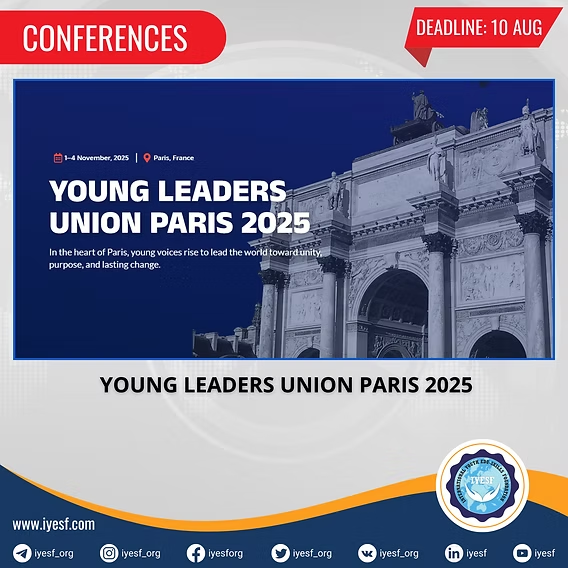
Young Leaders Union Conference 2025 in Paris (Fully Funded)
Join Global Changemakers in Paris! Fully Funded International Conference for Students, Professionals, and Social Leaders from All Nationalities and Fields

Yer yürəsinin daxili nüvəsində struktur dəyişiklikləri aşkar edilib
bu nəzəriyyənin doğru olmadığı məlum olub. Seismik dalğalar vasitəsilə aparılan tədqiqatda daxili nüvənin səthindəki dəyişikliklərə dair qeyri-adi məlumatlar əldə edilib.

Lester B Pearson Scholarship 2026 in Canada (Fully Funded)
Applications are now open for the Lester B Pearson Scholarship 2026 at the University of Toronto!