Applying to KAUST - Your Complete Guide for Masters & Ph.D. Programs (Upcoming Admissions)
Admissions Overview & Key Requirements


According to the Brookings Institution’s Center for Universal Education, the study draws on focus groups and interviews with K–12 students, parents, teachers, and technology experts across 50 countries. It also includes a review of hundreds of academic research articles examining AI’s impact on education.
Researchers found that while generative AI offers potential advantages, its current use in classrooms can weaken essential learning skills and disrupt healthy cognitive and social development.
Instead of analyzing long-term outcomes, the report aims to anticipate potential failures and consequences before they become irreversible.
The study outlines both the potential benefits and significant risks of AI in education and offers recommendations for teachers, parents, school leaders, and policymakers.
Pro: AI supports reading and writing skills
Teachers surveyed in the report say AI can be a useful tool for language learning, particularly for students acquiring a second language. AI can adapt reading materials to match a student’s skill level and provide a private learning environment for those who struggle in large classrooms.
Educators also report that AI can support writing development when used as a supplement rather than a replacement for student effort. Teachers say AI can help spark creativity, reduce writer’s block, and assist with organization, coherence, and grammar during drafting, as well as with editing and revision. The report emphasizes that AI is most effective when it supports—not replaces—the guidance of human teachers.
Con: AI threatens students’ cognitive development
The Brookings report identifies risks to children’s cognitive development as the most serious concern associated with AI in schools. Researchers warn that heavy reliance on AI can weaken students’ ability to think critically, learn new skills, and solve problems independently.
The report describes a potential “doom loop,” in which students increasingly offload thinking to AI tools, leading to cognitive decline similar to patterns seen in aging brains. Rebecca Winthrop, a senior fellow at Brookings and co-author of the study, cautions that when AI provides answers directly, students miss opportunities to evaluate evidence, distinguish fact from fiction, build strong arguments, and engage with diverse perspectives.
Pro: AI can reduce teachers’ workload
The report finds that AI can help teachers by automating routine tasks such as generating parent emails, translating materials, and creating worksheets, quizzes, rubrics, and lesson plans. Citing multiple studies, including research from the U.S., the report notes that teachers who use AI save an average of nearly six hours per week—roughly six weeks over a full school year.
Con: AI may improve or worsen educational equity
While AI has the potential to expand access to education, the report notes it could also deepen existing inequalities. Researchers point to Afghanistan as an example of AI’s promise, where programs have digitized curricula and delivered lessons in multiple languages via WhatsApp to girls barred from formal schooling.
Recommendations
The Brookings report offers a wide range of recommendations to help parents, teachers, policymakers, and technology companies reduce AI risks while preserving its benefits:
Finally, the authors stress that governments must regulate AI use in schools to protect students’ learning, mental health, and privacy.
Share
Applying to KAUST - Your Complete Guide for Masters & Ph.D. Programs (Upcoming Admissions)
Admissions Overview & Key Requirements

An mRNA cancer vaccine may offer long-term protection
A small clinical trial suggests the treatment could help keep pancreatic cancer from returning

Registration Opens for SAF 2025: International STEAM Azerbaijan Festival Welcomes Global Youth
The International STEAM Azerbaijan Festival (SAF) has officially opened registration for its 2025 edition!
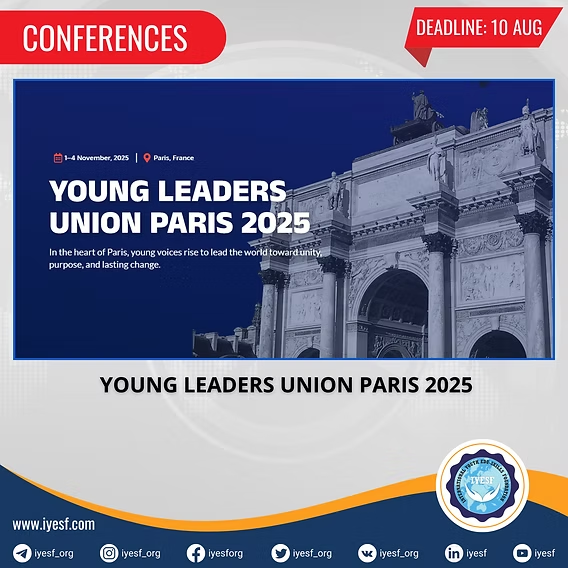
Young Leaders Union Conference 2025 in Paris (Fully Funded)
Join Global Changemakers in Paris! Fully Funded International Conference for Students, Professionals, and Social Leaders from All Nationalities and Fields

Yer yürəsinin daxili nüvəsində struktur dəyişiklikləri aşkar edilib
bu nəzəriyyənin doğru olmadığı məlum olub. Seismik dalğalar vasitəsilə aparılan tədqiqatda daxili nüvənin səthindəki dəyişikliklərə dair qeyri-adi məlumatlar əldə edilib.

Lester B Pearson Scholarship 2026 in Canada (Fully Funded)
Applications are now open for the Lester B Pearson Scholarship 2026 at the University of Toronto!