Applying to KAUST - Your Complete Guide for Masters & Ph.D. Programs (Upcoming Admissions)
Admissions Overview & Key Requirements


According to the BBC, the new guidance aims to improve allergy safety in schools, ensuring life-saving protection for children with food allergies and severe reactions. Early years minister Olivia Bailey said many schools already have strong policies in place, and the government is working with schools to implement the rules without expecting them to fund it from their core budgets.
School leaders have warned that proper funding will be essential. Paul Whiteman, general secretary of the NAHT union, said that the guidance “requires resourcing” and that “schools are not expected to fund this from their budgets.”
The initiative is part of wider government reforms, including changes to school food provision and the expansion of free school meals to 500,000 additional children this September.
Benedict Blythe, a five-year-old from Stamford in Lincolnshire, died in December 2021 after a school provided milk containing cow’s milk protein despite his known allergy. An investigation found the school failed to recognize his symptoms in time, delaying life-saving medication. His mother, Helen Blythe, described the announcement as “a truly remarkable day” and emphasized the need to prevent other families from experiencing similar tragedies.
According to the Department for Education, allergy-related illnesses or medical appointments caused the loss of 500,000 school days last year. The government hopes the new legal requirements will both save lives and keep more children in school.
Helen Houghton, headteacher at Warter Primary School in East Yorkshire, called the guidance “fundamental,” noting that 5% of her students have allergies, some of which are “quite complex.” The school has already allocated part of its budget to training additional staff and purchasing emergency equipment, while personally meeting parents to ensure individualized medical plans are in place.
While some schools already have allergy plans, the new rules make such measures mandatory across England. A 2024 Freedom of Information request by the Benedict Blythe Foundation revealed that 70% of schools did not have recommended allergy procedures, and half lacked adrenaline pens and spare auto-injectors.
Whiteman said the guidance will help schools provide inclusive education while maintaining student safety. Houghton added that effective allergy management also requires cultural and environmental adjustments, ensuring resources for lessons and experiments are allergy-safe.
Helen Blythe said she believes the changes will save lives: “This is the first generation of children to start school in a completely allergy-safe environment, and that is both exciting and magical.” The government is consulting parents, teachers, and experts before the measures come into force in September.
Share
Applying to KAUST - Your Complete Guide for Masters & Ph.D. Programs (Upcoming Admissions)
Admissions Overview & Key Requirements

An mRNA cancer vaccine may offer long-term protection
A small clinical trial suggests the treatment could help keep pancreatic cancer from returning

Registration Opens for SAF 2025: International STEAM Azerbaijan Festival Welcomes Global Youth
The International STEAM Azerbaijan Festival (SAF) has officially opened registration for its 2025 edition!
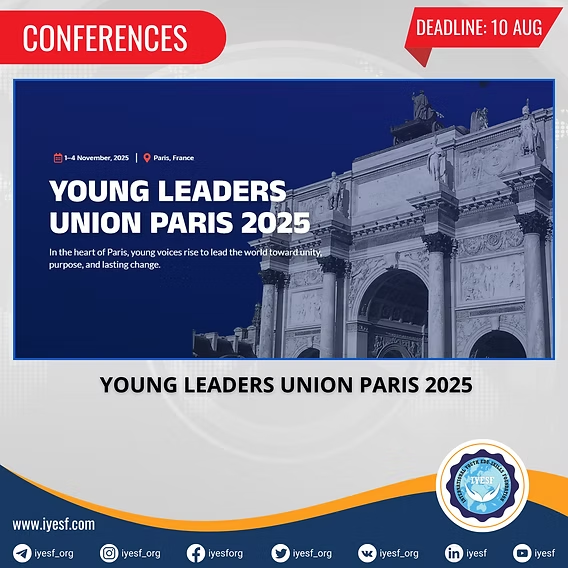
Young Leaders Union Conference 2025 in Paris (Fully Funded)
Join Global Changemakers in Paris! Fully Funded International Conference for Students, Professionals, and Social Leaders from All Nationalities and Fields

Yer yürəsinin daxili nüvəsində struktur dəyişiklikləri aşkar edilib
bu nəzəriyyənin doğru olmadığı məlum olub. Seismik dalğalar vasitəsilə aparılan tədqiqatda daxili nüvənin səthindəki dəyişikliklərə dair qeyri-adi məlumatlar əldə edilib.

Lester B Pearson Scholarship 2026 in Canada (Fully Funded)
Applications are now open for the Lester B Pearson Scholarship 2026 at the University of Toronto!