
Applying to KAUST - Your Complete Guide for Masters & Ph.D. Programs (Upcoming Admissions)
Admissions Overview & Key Requirements


Children/ File: Cato Institute
According to Cato Institute, educational freedom is growing rapidly across the United States. More than 70 school choice programs are currently active in over 30 states, giving families greater control over their children’s education than ever before. However, this expansion has also revealed an important challenge: creating a school choice program is relatively simple, but building one that functions effectively and remains sustainable over time is much more difficult.
For this reason, I am pleased to introduce my new report, Let 1,000 Flowers Bloom: Best Practices for Advancing Educational Freedom.
Many states have experienced similar difficulties after introducing school choice programs. Louisiana’s LA GATOR initiative, launched in 2025 with universal eligibility, was only able to support 6,000 students out of nearly 40,000 applicants. In North Carolina, 54,000 families were left waiting until lawmakers overturned a veto and approved additional funding. Utah also faced major demand, with around 17,000 students placed on waiting lists during the program’s first year. Without strong policy design, families often encounter delays, bureaucracy, and missed educational opportunities.
So, what makes a successful program?
Universal eligibility is the foundation. Restricting access based on income levels or special-needs categories leaves some children stuck in schools that do not meet their needs, while other families end up paying both taxes and private tuition. Broader participation also encourages competition, which helps create more educational opportunities.
Reliable funding is equally important to ensure that every eligible student can participate. This can be achieved by connecting program funding to state per-pupil funding formulas, as seen in Arizona and Florida, or by introducing automatic increases when demand grows. New Hampshire’s Education Freedom Accounts, for example, expand by 25 percent whenever enrollment reaches 90 percent of available capacity.
Rollover funding policies allow unused money to carry over from year to year. This prevents families from feeling pressured to spend funds unnecessarily and helps them prepare for future educational expenses as their children grow older.
Competitive administration is another key factor. In many states, a single company manages ESA accounts, payments, and approvals, creating monopolies that often overlook the needs of families. Allowing multiple providers to compete shifts the focus toward serving parents rather than bureaucratic systems.
Simplified spending approval systems also improve the daily experience for families. Features such as debit cards, automatic approvals with risk-based audits, optional online marketplaces, and flexible reimbursement methods reduce unnecessary obstacles for parents using educational choice programs.
In the report, I also explore different policy models, including ESAs, tax-credit ESAs, refundable tax credits, and the proposed Universal Tuition Tax Credit. Florida and Arizona are highlighted as examples of how combining multiple programs can create a stable and lasting educational ecosystem. In Florida, more than half of all students now attend a school chosen through educational choice options.
As the report explains:
“The true measure of educational freedom is whether families can depend on it consistently year after year, not only when lawmakers approve funding. A well-designed system ensures that resources follow students, opportunities expand with demand, and families-not bureaucracies or monopolies-shape educational decisions.”
By adopting thoughtful reforms and incorporating these key features, states can ensure that the current momentum behind educational freedom becomes a permanent and successful part of the American education system.
With students gaining access to a wider variety of educational opportunities, the future looks promising. This report aims to support and strengthen the programs helping to shape that future.
Share
Applying to KAUST - Your Complete Guide for Masters & Ph.D. Programs (Upcoming Admissions)
Admissions Overview & Key Requirements

An mRNA cancer vaccine may offer long-term protection
A small clinical trial suggests the treatment could help keep pancreatic cancer from returning

Registration Opens for SAF 2025: International STEAM Azerbaijan Festival Welcomes Global Youth
The International STEAM Azerbaijan Festival (SAF) has officially opened registration for its 2025 edition!
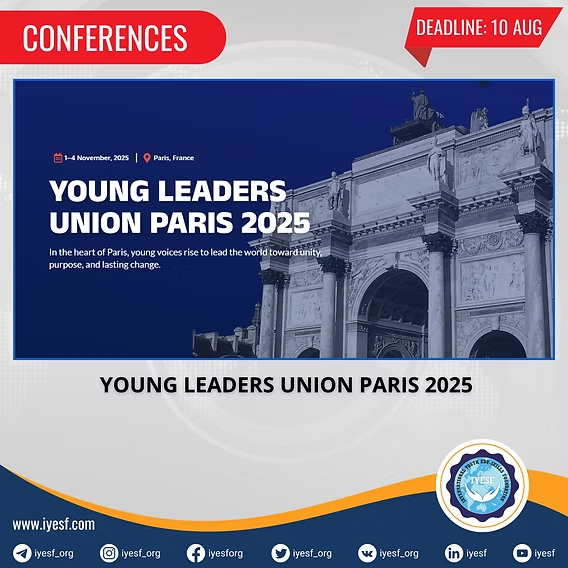
Young Leaders Union Conference 2025 in Paris (Fully Funded)
Join Global Changemakers in Paris! Fully Funded International Conference for Students, Professionals, and Social Leaders from All Nationalities and Fields

Yer yürəsinin daxili nüvəsində struktur dəyişiklikləri aşkar edilib
bu nəzəriyyənin doğru olmadığı məlum olub. Seismik dalğalar vasitəsilə aparılan tədqiqatda daxili nüvənin səthindəki dəyişikliklərə dair qeyri-adi məlumatlar əldə edilib.

Lester B Pearson Scholarship 2026 in Canada (Fully Funded)
Applications are now open for the Lester B Pearson Scholarship 2026 at the University of Toronto!