Applying to KAUST - Your Complete Guide for Masters & Ph.D. Programs (Upcoming Admissions)
Admissions Overview & Key Requirements

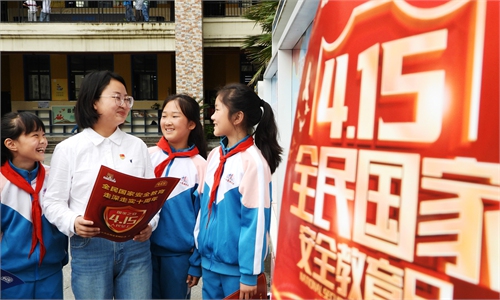
Schoolchildren and a teacher/ File: Global Times
According to China Daily, the newly introduced majors reflect China’s focus on strategic priorities, industrial transformation, and future technological advancements. According to the Ministry of Education of China, the programs are designed to support emerging sectors while upgrading traditional industries and strengthening the country’s innovation capacity.
Among the new offerings are programs in energy science and engineering and deep-earth science and engineering, which address national strategic needs. To modernize traditional sectors, majors such as transportation and energy integration engineering and agricultural robotics have also been introduced.
Future-oriented industries are represented through fields like biotechnology manufacturing and brain-computer science and technology, while service-sector innovation is supported by majors including digital culture and tourism and commercial artificial intelligence. Additionally, programs such as digital trade and digital finance aim to strengthen the intelligent economy.
A notable addition is the major in embodied intelligence, which merges next-generation artificial intelligence with real-world applications. Nine leading universities, including Harbin Institute of Technology and Beihang University, have been authorized to offer this program.
For the first time, the “interdisciplinary studies” category has been expanded to include 15 programs, incorporating new majors such as embodied intelligence and brain-computer science and technology. With these additions, the total number of undergraduate majors in China has reached 883.
The ministry also highlighted broader reforms in higher education during the 14th Five-Year Plan period (2021–2025). Universities added 10,200 undergraduate program slots while cutting or suspending 12,200 others, marking a significant restructuring effort. The annual adjustment rate of majors exceeded 10 percent for the first time this year.
Brain-computer interface technology, identified as a priority in China’s upcoming 15th Five-Year Plan (2026–2030), is expected to have wide-ranging applications. Tianjin University’s program will equip students with expertise across the entire technology chain—from devices and chips to algorithms, systems, and applications.
Students enrolled in this major will begin developing their knowledge from the first year, engaging in specialized research programs such as the “brain talker” initiative alongside a broad selection of elective courses. The curriculum is designed to provide both strong theoretical foundations and practical skills, enabling graduates to tackle complex engineering challenges and contribute to the advancement of intelligent human-computer interaction.
The introduction of these new majors underscores China’s commitment to aligning higher education with technological innovation, economic transformation, and future workforce demands.
Share
Applying to KAUST - Your Complete Guide for Masters & Ph.D. Programs (Upcoming Admissions)
Admissions Overview & Key Requirements

An mRNA cancer vaccine may offer long-term protection
A small clinical trial suggests the treatment could help keep pancreatic cancer from returning

Registration Opens for SAF 2025: International STEAM Azerbaijan Festival Welcomes Global Youth
The International STEAM Azerbaijan Festival (SAF) has officially opened registration for its 2025 edition!
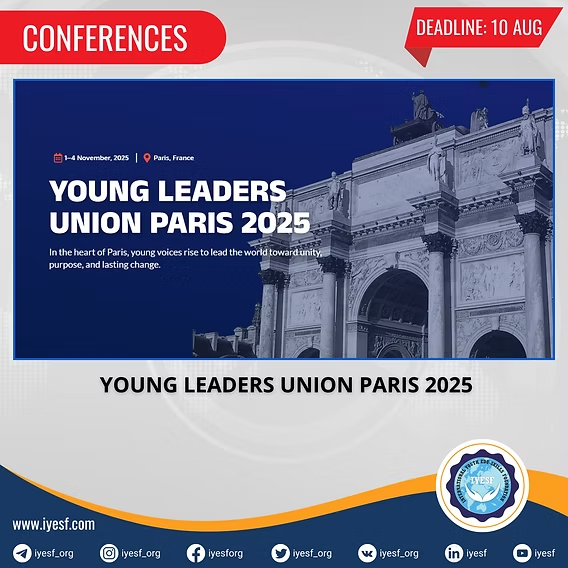
Young Leaders Union Conference 2025 in Paris (Fully Funded)
Join Global Changemakers in Paris! Fully Funded International Conference for Students, Professionals, and Social Leaders from All Nationalities and Fields

Yer yürəsinin daxili nüvəsində struktur dəyişiklikləri aşkar edilib
bu nəzəriyyənin doğru olmadığı məlum olub. Seismik dalğalar vasitəsilə aparılan tədqiqatda daxili nüvənin səthindəki dəyişikliklərə dair qeyri-adi məlumatlar əldə edilib.

Lester B Pearson Scholarship 2026 in Canada (Fully Funded)
Applications are now open for the Lester B Pearson Scholarship 2026 at the University of Toronto!