Applying to KAUST - Your Complete Guide for Masters & Ph.D. Programs (Upcoming Admissions)
Admissions Overview & Key Requirements


The Universities of Greenwich and Kent have confirmed that they have been granted official approval to merge, creating what is set to become the third-largest higher education institution in the UK.
According to The Guardian, the merged entity is currently consulting on being named the London and South East University Group. The University of Greenwich’s vice-chancellor, Professor Jane Harrington, will serve as the designate vice-chancellor of the new university group.
The two institutions first announced plans to merge in September last year, describing the move as a “blueprint for others to follow” in response to mounting challenges facing UK universities.
On Wednesday, both universities confirmed that all legal documentation for the merger has been formally signed and that approval has been received from the Department for Education and the higher education regulator, the Office for Students.
The merged university group is set to officially come into existence on 1 August 2026. Despite the merger, Greenwich and Kent will continue to operate as separate academic divisions, retaining their current names.
Students will continue to apply to, study at and graduate from their chosen university, the institutions said.
All staff from both universities will be employed by the new university group, which will operate under a single vice-chancellor, one board of governors and a unified executive team.
Senior executive appointments are expected to be confirmed by April and are set to include the University of Kent’s acting vice-chancellor, Professor Georgina Randsley de Moura.
The merger comes at a time when UK universities are facing significant financial strain. As previously reported by The Guardian, the Office for Students warned last year that around 45% of higher education providers could be running a deficit in the 2024–25 academic year.
Share
Applying to KAUST - Your Complete Guide for Masters & Ph.D. Programs (Upcoming Admissions)
Admissions Overview & Key Requirements

An mRNA cancer vaccine may offer long-term protection
A small clinical trial suggests the treatment could help keep pancreatic cancer from returning

Registration Opens for SAF 2025: International STEAM Azerbaijan Festival Welcomes Global Youth
The International STEAM Azerbaijan Festival (SAF) has officially opened registration for its 2025 edition!
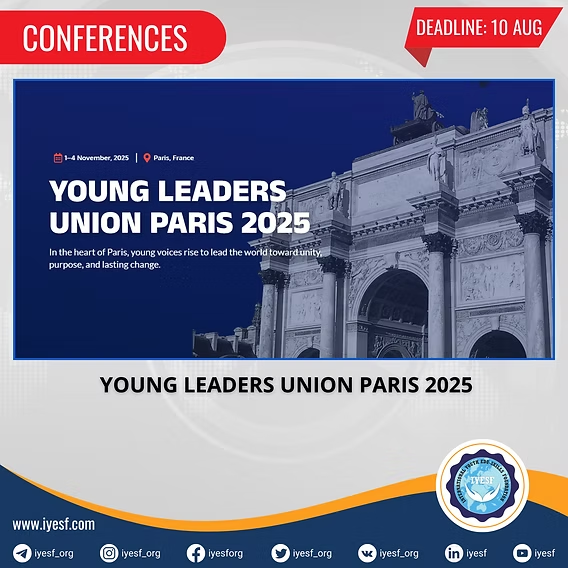
Young Leaders Union Conference 2025 in Paris (Fully Funded)
Join Global Changemakers in Paris! Fully Funded International Conference for Students, Professionals, and Social Leaders from All Nationalities and Fields

Yer yürəsinin daxili nüvəsində struktur dəyişiklikləri aşkar edilib
bu nəzəriyyənin doğru olmadığı məlum olub. Seismik dalğalar vasitəsilə aparılan tədqiqatda daxili nüvənin səthindəki dəyişikliklərə dair qeyri-adi məlumatlar əldə edilib.

Lester B Pearson Scholarship 2026 in Canada (Fully Funded)
Applications are now open for the Lester B Pearson Scholarship 2026 at the University of Toronto!