Applying to KAUST - Your Complete Guide for Masters & Ph.D. Programs (Upcoming Admissions)
Admissions Overview & Key Requirements


Exam preparation / File: Greater University Tutoring Service
With examination periods becoming increasingly demanding across universities and colleges, students are often confronted not only with academic challenges but also with time pressure and information overload. In many cases, academic performance is less dependent on the number of hours spent studying and more closely linked to the effectiveness of study strategies used.

Educational psychology research consistently shows that passive learning methods, such as rereading notes or highlighting text, produce limited long-term retention. In contrast, structured and active learning approaches significantly improve recall, comprehension, and performance under exam conditions. As a result, several evidence-based preparation methods have become widely recommended for higher education students seeking more reliable academic outcomes. Here is the most effective methods that could make your next exam weak easier.
1. Active Recall.
Active recall is a learning technique based on retrieving information from memory without immediate access to study materials. Instead of reviewing content passively, students are required to actively reconstruct knowledge, for example by answering questions, using flashcards, or writing explanations from memory. This process strengthens neural pathways associated with long-term memory storage. Research in cognitive science indicates that retrieval practice improves both retention and the ability to apply knowledge in different contexts, making it particularly effective for written and oral examinations.
2. Spaced Repetition.
Spaced repetition is a structured review method in which learning material is revisited at increasing intervals. Rather than concentrating study efforts into a single session, information is reviewed multiple times over days or weeks. This approach is grounded in the “forgetting curve” theory, which demonstrates that memory retention declines rapidly without reinforcement. By re-exposing the brain to material at strategically timed intervals, students significantly improve long-term retention and reduce the likelihood of forgetting key concepts before exams.
3. Practice Testing.
Practice testing involves completing past examination papers, sample questions, or mock tests under timed conditions. This method not only reinforces subject knowledge but also develops exam-specific skills such as time management, question interpretation, and stress control. By replicating actual exam conditions, students can identify knowledge gaps and adjust their preparation accordingly. Studies have shown that repeated testing is one of the most effective predictors of academic performance, particularly in high-stakes examinations.
4. Structured Study Scheduling.
Effective exam preparation also depends on how study time is organized. Structured study systems, such as time-blocking or the Pomodoro technique, divide study periods into focused intervals separated by short breaks. This method is supported by research on attention span and cognitive fatigue, which suggests that sustained concentration declines over time. Structured scheduling helps maintain cognitive efficiency, reduces mental exhaustion, and promotes consistent productivity across longer study periods.
In general Effective exam preparation is less about the volume of time spent studying and more about the quality and structure of that time. Evidence-based strategies such as active recall, spaced repetition, practice testing, and structured study scheduling provide students with reliable tools to improve understanding, strengthen memory retention, and perform more confidently under exam conditions. As academic demands continue to increase in higher education, adopting these methods can make exam preparation more efficient, consistent, and results-oriented.
Share
Applying to KAUST - Your Complete Guide for Masters & Ph.D. Programs (Upcoming Admissions)
Admissions Overview & Key Requirements

An mRNA cancer vaccine may offer long-term protection
A small clinical trial suggests the treatment could help keep pancreatic cancer from returning

Registration Opens for SAF 2025: International STEAM Azerbaijan Festival Welcomes Global Youth
The International STEAM Azerbaijan Festival (SAF) has officially opened registration for its 2025 edition!
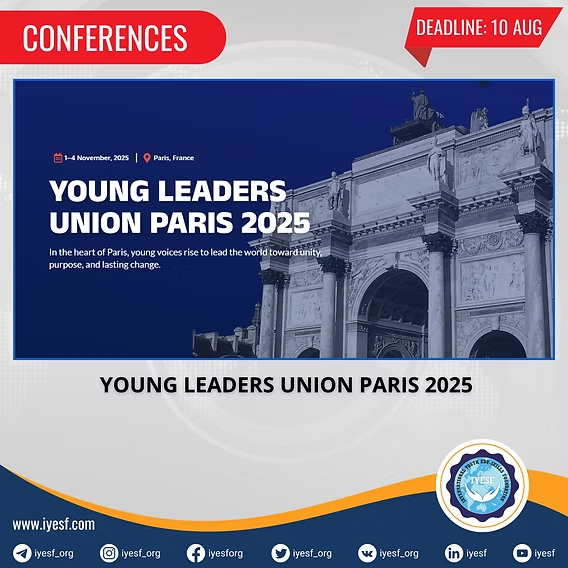
Young Leaders Union Conference 2025 in Paris (Fully Funded)
Join Global Changemakers in Paris! Fully Funded International Conference for Students, Professionals, and Social Leaders from All Nationalities and Fields

Yer yürəsinin daxili nüvəsində struktur dəyişiklikləri aşkar edilib
bu nəzəriyyənin doğru olmadığı məlum olub. Seismik dalğalar vasitəsilə aparılan tədqiqatda daxili nüvənin səthindəki dəyişikliklərə dair qeyri-adi məlumatlar əldə edilib.

Lester B Pearson Scholarship 2026 in Canada (Fully Funded)
Applications are now open for the Lester B Pearson Scholarship 2026 at the University of Toronto!