Applying to KAUST - Your Complete Guide for Masters & Ph.D. Programs (Upcoming Admissions)
Admissions Overview & Key Requirements

File: Webwise
Paddy Rodgers, director of the Royal Museums Greenwich group, which oversees the Observatory, said:
"A reliance solely on instant answers risks losing the habits of questioning and evaluation that underpin knowledge, expertise, and innovation."
Rodgers pointed to the Observatory’s 350-year history, noting that early astronomers produced massive amounts of data through painstaking work that machines would not have done. These efforts created resources that proved invaluable decades later, helping future scientists verify ideas and uncover unexpected discoveries.
While AI has contributed to breakthroughs - like Sir Demis Hassabis’ AI-driven protein research, which won a 2024 Nobel Prize -Rodgers emphasized that machines cannot replace the human curiosity and problem-solving that drive innovation.
Experts say AI can enhance research and learning when used responsibly. Reid Hoffman, LinkedIn co-founder, described AI as a “transformation of cognitive excellence” and suggested using it as a counterpoint to human thinking:
"For example, ask AI 'What's wrong with my idea?' to challenge yourself."
However, Dr Anuschka Schmitt of the London School of Economics warned that AI lowers the cognitive effort needed for tasks, which can negatively affect memory, learning, and critical thinking. Instant AI answers may also omit context or verifiable sources, distancing users from reliable information.
Generative AI tools continue to advance rapidly, producing text, images, video, and audio, and are increasingly shaping platforms like Google, TikTok, and X. Yet Rodgers and experts stress that human inquiry remains irreplaceable: discovering, questioning, and exploring unknowns cannot be fully outsourced to machines.
The Observatory’s ongoing First Light project aims to preserve and interpret the discoveries and passion of past astronomers, highlighting the enduring importance of human curiosity alongside technological innovation.
Share
Applying to KAUST - Your Complete Guide for Masters & Ph.D. Programs (Upcoming Admissions)
Admissions Overview & Key Requirements

An mRNA cancer vaccine may offer long-term protection
A small clinical trial suggests the treatment could help keep pancreatic cancer from returning

Registration Opens for SAF 2025: International STEAM Azerbaijan Festival Welcomes Global Youth
The International STEAM Azerbaijan Festival (SAF) has officially opened registration for its 2025 edition!
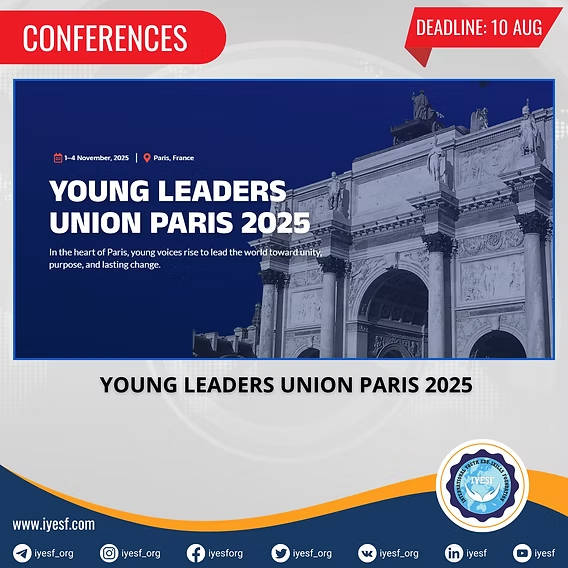
Young Leaders Union Conference 2025 in Paris (Fully Funded)
Join Global Changemakers in Paris! Fully Funded International Conference for Students, Professionals, and Social Leaders from All Nationalities and Fields

Yer yürəsinin daxili nüvəsində struktur dəyişiklikləri aşkar edilib
bu nəzəriyyənin doğru olmadığı məlum olub. Seismik dalğalar vasitəsilə aparılan tədqiqatda daxili nüvənin səthindəki dəyişikliklərə dair qeyri-adi məlumatlar əldə edilib.

Lester B Pearson Scholarship 2026 in Canada (Fully Funded)
Applications are now open for the Lester B Pearson Scholarship 2026 at the University of Toronto!