
Applying to KAUST - Your Complete Guide for Masters & Ph.D. Programs (Upcoming Admissions)
Admissions Overview & Key Requirements


The pilot programme across Sutton schools has reported improved pupil attendance and behaviour and reduced exam anxiety/ File: Alistair Berg/Getty Images
All 15 secondary schools in the borough are taking part in the pilot programme. Students can access a seven-minute VR session either at scheduled times or when they feel overwhelmed and need to step out of class. The aim is to help them calm down, rebuild confidence and return to lessons more focused, The Guardian reports.
Early results are promising. In the first 10 schools involved, nine out of 10 students reported an immediate reduction in stress after using the VR headsets. Educators say the programme has also led to improvements in attendance and behaviour, as well as reduced anxiety around exams and assessments.
Aelisha Needham, deputy head responsible for ethics at Ark Academy in north London, said the technology is mainly used for students experiencing social, emotional or mental health difficulties, particularly those with ADHD or anxiety. She noted that even a short session can “clear students’ minds” and help them concentrate better.
Sixteen-year-old student Laura Wilson described the experience as “like being somewhere else.” She said the programme has helped her manage exam anxiety and better understand her emotions. “Exams used to really scare me. Now they don’t feel as overwhelming,” she said.
The project is being run in collaboration with child and adolescent mental health services (CAMHS) in south-west London. Experts believe VR could offer a cost-effective and accessible solution for schools at a time when traditional mental health services are under increasing pressure.
Mental health leaders have welcomed the initiative, saying that digital tools can play an important role in supporting student wellbeing. Schools that take a broad approach to mental health, they add, are better able to support inclusion, achievement, attendance and behaviour.
The outcomes of the pilot will help determine whether the technology could be rolled out more widely in the future.
Share
Applying to KAUST - Your Complete Guide for Masters & Ph.D. Programs (Upcoming Admissions)
Admissions Overview & Key Requirements

An mRNA cancer vaccine may offer long-term protection
A small clinical trial suggests the treatment could help keep pancreatic cancer from returning

Registration Opens for SAF 2025: International STEAM Azerbaijan Festival Welcomes Global Youth
The International STEAM Azerbaijan Festival (SAF) has officially opened registration for its 2025 edition!
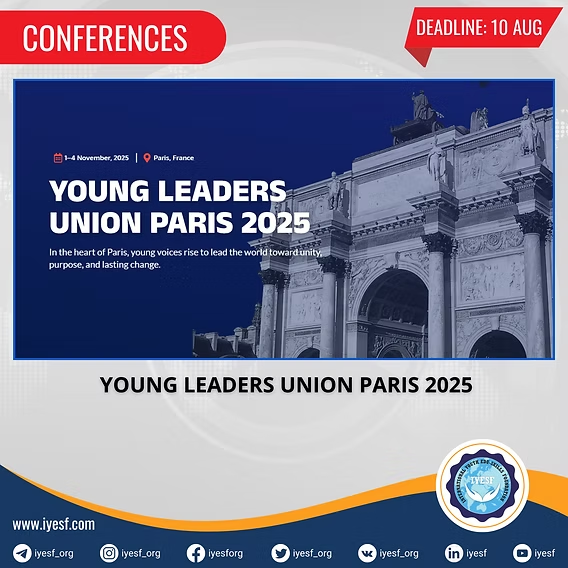
Young Leaders Union Conference 2025 in Paris (Fully Funded)
Join Global Changemakers in Paris! Fully Funded International Conference for Students, Professionals, and Social Leaders from All Nationalities and Fields

Yer yürəsinin daxili nüvəsində struktur dəyişiklikləri aşkar edilib
bu nəzəriyyənin doğru olmadığı məlum olub. Seismik dalğalar vasitəsilə aparılan tədqiqatda daxili nüvənin səthindəki dəyişikliklərə dair qeyri-adi məlumatlar əldə edilib.

Lester B Pearson Scholarship 2026 in Canada (Fully Funded)
Applications are now open for the Lester B Pearson Scholarship 2026 at the University of Toronto!