
Applying to KAUST - Your Complete Guide for Masters & Ph.D. Programs (Upcoming Admissions)
Admissions Overview & Key Requirements

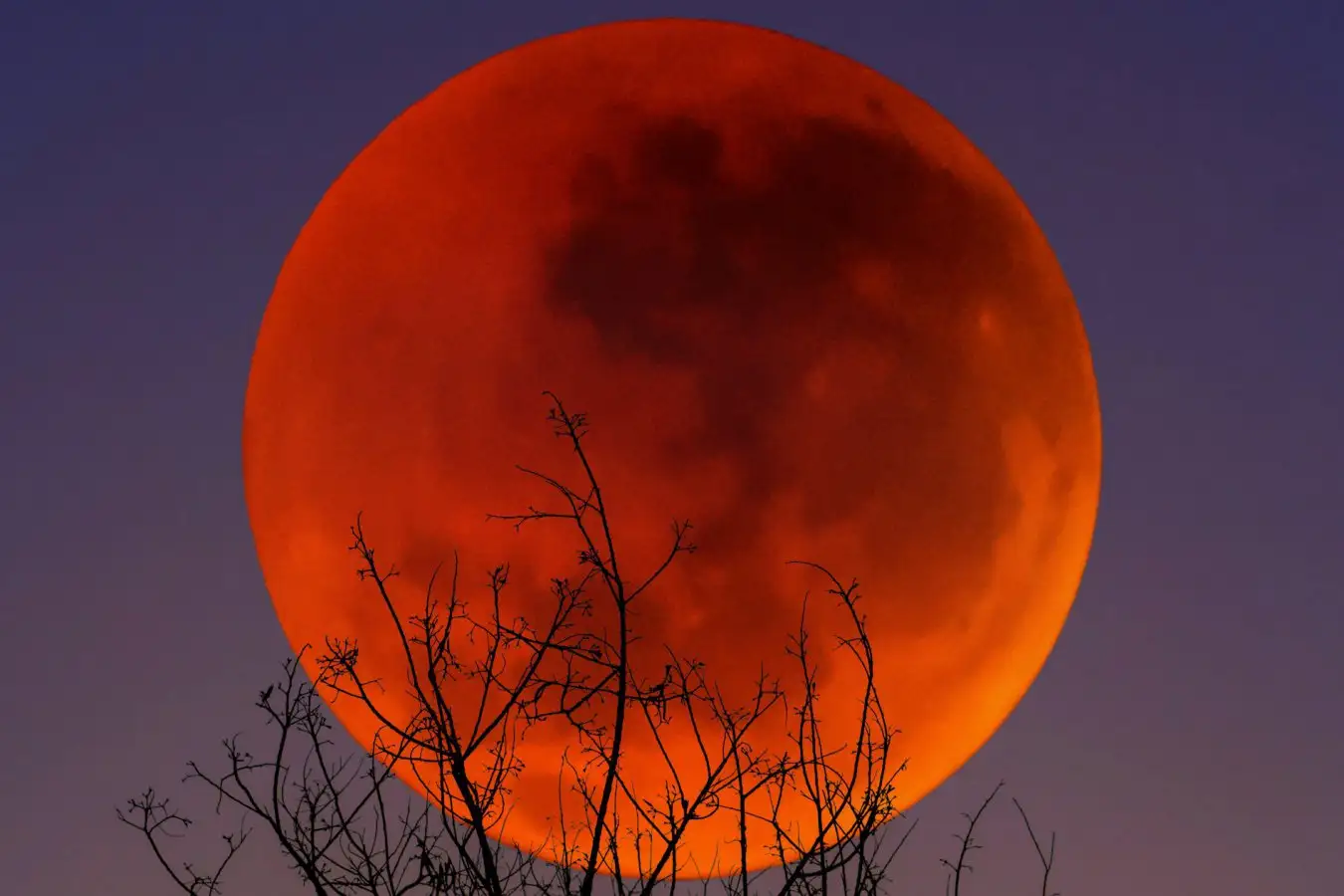
According to the BBC, on 3 March 2026, skywatchers across several parts of the world will witness a total lunar eclipse — a striking astronomical event that can turn the Moon a deep shade of red.
Often called a “Blood Moon,” this phenomenon occurs when the Moon takes on a reddish glow during the eclipse.
The event will not be visible from the UK, Europe or Africa. Instead, the clearest views are expected in North America, the Pacific region, Australia and parts of East Asia.
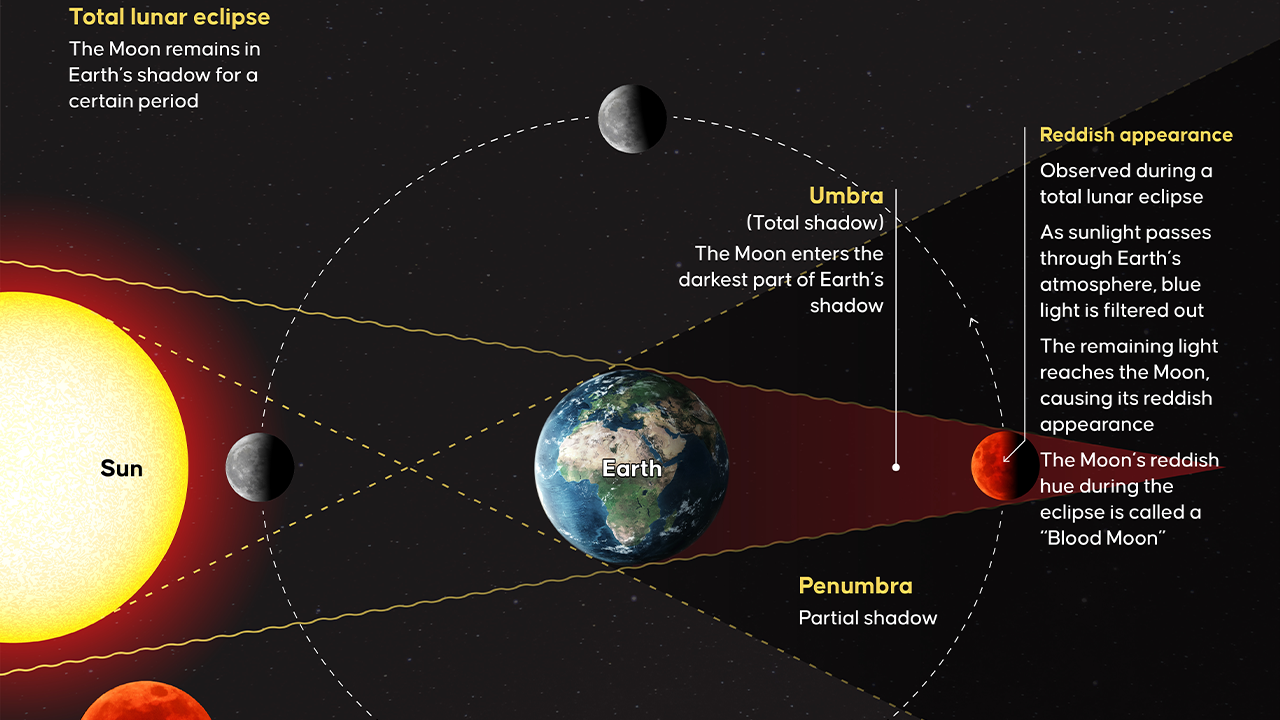
A lunar eclipse happens because of the way the Sun, Earth and Moon move in space. The Moon travels around the Earth, while the Earth orbits the Sun. At certain moments, these three bodies align in a straight line.
We always see the same side of the Moon because it rotates on its axis in the same amount of time it takes to orbit the Earth — approximately 27 days. This synchronized movement keeps one face permanently turned toward our planet.
A total lunar eclipse takes place when the Earth positions itself directly between the Sun and the Moon. As a result, the Earth blocks sunlight and its shadow falls across the Moon’s surface.
This alignment can only occur during a full Moon, when the Moon is located on the opposite side of the Earth from the Sun. If only a portion of the Moon passes into Earth’s shadow, the event is known as a partial lunar eclipse.
This should not be confused with normal lunar phases — such as crescent or half Moon — which simply reflect how much of the Moon’s surface is illuminated by the Sun at a given time.
Unlike a solar eclipse, where the Sun appears darkened, the Moon remains visible during a total lunar eclipse. Instead of disappearing, it glows in shades of red or orange.
The reason lies in Earth’s atmosphere. As sunlight travels through the atmosphere, shorter blue wavelengths are scattered in different directions — the same process that makes the sky look blue. Meanwhile, red and orange wavelengths pass through more easily.
This filtered reddish light bends around the Earth and reaches the Moon, giving it a copper-coloured appearance in the night sky.
Share
Applying to KAUST - Your Complete Guide for Masters & Ph.D. Programs (Upcoming Admissions)
Admissions Overview & Key Requirements

An mRNA cancer vaccine may offer long-term protection
A small clinical trial suggests the treatment could help keep pancreatic cancer from returning

Registration Opens for SAF 2025: International STEAM Azerbaijan Festival Welcomes Global Youth
The International STEAM Azerbaijan Festival (SAF) has officially opened registration for its 2025 edition!

Young Leaders Union Conference 2025 in Paris (Fully Funded)
Join Global Changemakers in Paris! Fully Funded International Conference for Students, Professionals, and Social Leaders from All Nationalities and Fields

Yer yürəsinin daxili nüvəsində struktur dəyişiklikləri aşkar edilib
bu nəzəriyyənin doğru olmadığı məlum olub. Seismik dalğalar vasitəsilə aparılan tədqiqatda daxili nüvənin səthindəki dəyişikliklərə dair qeyri-adi məlumatlar əldə edilib.

Lester B Pearson Scholarship 2026 in Canada (Fully Funded)
Applications are now open for the Lester B Pearson Scholarship 2026 at the University of Toronto!