Applying to KAUST - Your Complete Guide for Masters & Ph.D. Programs (Upcoming Admissions)
Admissions Overview & Key Requirements

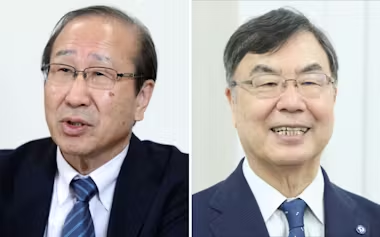
The recent announcement of two Japanese researchers winning the Nobel Prize has intensified calls on the government to provide support for improving the research environment, with the laureates themselves stressing that sustained support for basic science is critical for future success.
Following the announcement, Nobel Laureates—including Chemistry winner Professor Susumu Kitagawa of Kyoto University and Medicine winner Professor Shimon Sakaguchi of Osaka University—publicly urged the government to prioritize and enhance support for foundational research, noting that Japan’s current academic environment is falling behind its international peers.
A key concern is the deteriorating financial stability of institutions. Core operational funding from the government for national universities has been cut by 13% since 2004, and while the decline has recently slowed, inflation is causing the real value of research funds to shrink.
Furthermore, researchers are finding it increasingly difficult to dedicate time to their work. Professor Kitagawa highlighted that university faculty now spend only 32.2% of their annual working hours on research, a drop of more than ten percentage points in two decades.
The environment for young academics is particularly precarious, with nearly 60% of national university faculty under 40 now on fixed-term contracts. This unstable employment makes it challenging for emerging scholars to settle down and focus on long-term research projects.
The cumulative effect of these issues is already evident in Japan's global scientific standing. According to the "Science and Technology Indicators 2025" compiled by the Ministry of Education, Culture, Sports, Science and Technology (MEXT), the number of "highly-cited papers" (those in the top 10% of citations from other researchers' papers) from Japan has fallen from 4th place in the world in the early 2000s to 13th place. To foster the next generation of Nobel Prize winners, it is an urgent necessity to improve and raise the standard of the research environment.
Share
Applying to KAUST - Your Complete Guide for Masters & Ph.D. Programs (Upcoming Admissions)
Admissions Overview & Key Requirements

An mRNA cancer vaccine may offer long-term protection
A small clinical trial suggests the treatment could help keep pancreatic cancer from returning

Registration Opens for SAF 2025: International STEAM Azerbaijan Festival Welcomes Global Youth
The International STEAM Azerbaijan Festival (SAF) has officially opened registration for its 2025 edition!
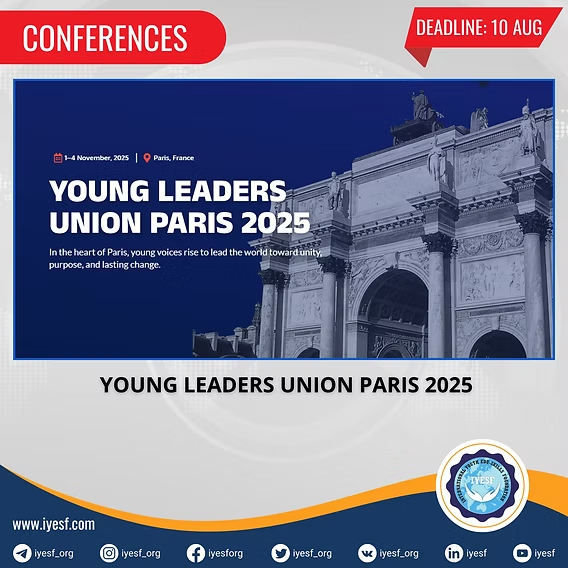
Young Leaders Union Conference 2025 in Paris (Fully Funded)
Join Global Changemakers in Paris! Fully Funded International Conference for Students, Professionals, and Social Leaders from All Nationalities and Fields

Yer yürəsinin daxili nüvəsində struktur dəyişiklikləri aşkar edilib
bu nəzəriyyənin doğru olmadığı məlum olub. Seismik dalğalar vasitəsilə aparılan tədqiqatda daxili nüvənin səthindəki dəyişikliklərə dair qeyri-adi məlumatlar əldə edilib.

Lester B Pearson Scholarship 2026 in Canada (Fully Funded)
Applications are now open for the Lester B Pearson Scholarship 2026 at the University of Toronto!