Applying to KAUST - Your Complete Guide for Masters & Ph.D. Programs (Upcoming Admissions)
Admissions Overview & Key Requirements


Following the 2008 global financial crash, economics students in the US and UK began challenging how the subject was taught. At Harvard University, students walked out of an introductory economics class, arguing it promoted a “specific and limited view” that reinforced “a problematic and inefficient system of economic inequality.” Meanwhile, at Manchester University, students unhappy with rigid mathematical formulas that bore little relation to the economic reality around them established a “post-crash economics society.”
These early acts of discontent converged in 2013 at the London School of Economics (LSE) with the inaugural meeting of Rethinking Economics, a student-led organisation now active in over 40 countries with thousands of members, including leading economists.
Rethinking Economics advocates for teaching economics in a more pluralist, ethically aware, historically grounded, and real-world-oriented way. The movement aims to ensure that economics is not dominated by a single framework presented as “neutral” or “objective,” but rather one that incorporates ecology, power, institutions, history, and inequality into the study of economic systems.
Since 2019, the movement has reported more than 80 campaign successes across 35 countries, including 23 major curriculum reforms, reshaping what students learn as mainstream economics. Examples include the launch of a Politics, Philosophy and Economics course at Goldsmiths, University of London in 2014, an interdisciplinary programme at the University of Lille in France in 2020, and an Economics and Society undergraduate programme and a Public Sector Economics master’s programme at Leiden University in 2023.
Academics have welcomed the initiative, noting it encourages students to critically engage with urgent global issues—from economic inequality and militarism to climate change—rather than accepting narrow, purely mathematical approaches. The campaign continues to grow as students demand education that addresses real-world challenges, offering courses and events that provide progressive economic perspectives previously unavailable in traditional curricula.
Source: The Guardian
Share
Applying to KAUST - Your Complete Guide for Masters & Ph.D. Programs (Upcoming Admissions)
Admissions Overview & Key Requirements

An mRNA cancer vaccine may offer long-term protection
A small clinical trial suggests the treatment could help keep pancreatic cancer from returning

Registration Opens for SAF 2025: International STEAM Azerbaijan Festival Welcomes Global Youth
The International STEAM Azerbaijan Festival (SAF) has officially opened registration for its 2025 edition!
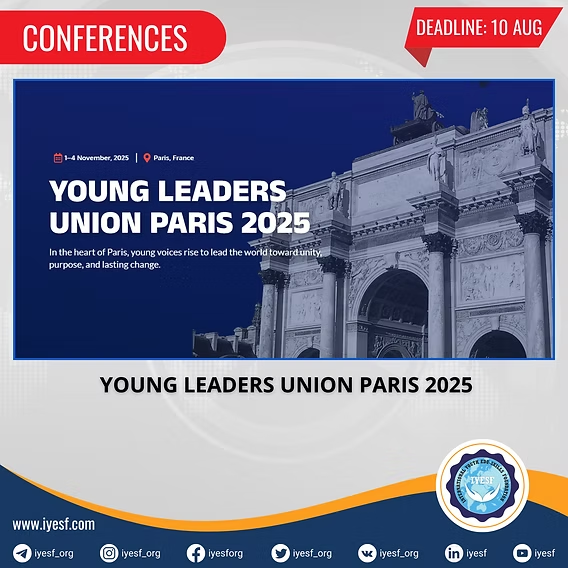
Young Leaders Union Conference 2025 in Paris (Fully Funded)
Join Global Changemakers in Paris! Fully Funded International Conference for Students, Professionals, and Social Leaders from All Nationalities and Fields

Yer yürəsinin daxili nüvəsində struktur dəyişiklikləri aşkar edilib
bu nəzəriyyənin doğru olmadığı məlum olub. Seismik dalğalar vasitəsilə aparılan tədqiqatda daxili nüvənin səthindəki dəyişikliklərə dair qeyri-adi məlumatlar əldə edilib.

Lester B Pearson Scholarship 2026 in Canada (Fully Funded)
Applications are now open for the Lester B Pearson Scholarship 2026 at the University of Toronto!