Applying to KAUST - Your Complete Guide for Masters & Ph.D. Programs (Upcoming Admissions)
Admissions Overview & Key Requirements


Slovakia is rolling out a comprehensive reform of adult education as part of a broader effort to prepare its workforce for rapid technological and economic change. The Ministry of Education says lifelong learning is no longer optional, but essential for the country’s long-term competitiveness.
The reform responds to mounting evidence that adult skills in Slovakia are declining while participation in education remains low. International data from the OECD’s PIAAC survey show that Slovakia has experienced one of the steepest drops in adult reading literacy in Europe. Less than 30% of adults engage in any form of learning, with most "training" being limited to mandatory safety briefings (BOZP) rather than career-boosting skills.
The reform focuses on building a flexible, accessible, and skills-oriented lifelong learning system. For this purpose, the Ministry is developing short and flexible forms of education, so-called micro-certificates. These are smaller educational blocks that allow for quick completion of qualifications without the need to complete the entire course of study. This approach significantly increases the accessibility of education, especially for working people.
An important part of the proposal is the formal recognition of informal learning. For the first time, people who have worked in a trade for years but lack a school diploma can take "Master Exams" (majstrovské skúšky). Passing this exam grants the title of "Master" (Majster), which the state will now legally accept as a valid qualification to obtain a business license (živnostenské oprávnenie). This removes the barrier for thousands of skilled "self-taught" workers to finally start their own legal businesses.
To tackle the financial barrier, the Ministry is also launching Individual Learning Accounts. People aged 16 to 65 will have access to a verified offer of courses and training in one place. The portal will be linked to the so-called individual education accounts, through which the state will contribute 200 euros to education for 5,000 people in a pilot phase from April 2026.
Share
Applying to KAUST - Your Complete Guide for Masters & Ph.D. Programs (Upcoming Admissions)
Admissions Overview & Key Requirements

An mRNA cancer vaccine may offer long-term protection
A small clinical trial suggests the treatment could help keep pancreatic cancer from returning

Registration Opens for SAF 2025: International STEAM Azerbaijan Festival Welcomes Global Youth
The International STEAM Azerbaijan Festival (SAF) has officially opened registration for its 2025 edition!
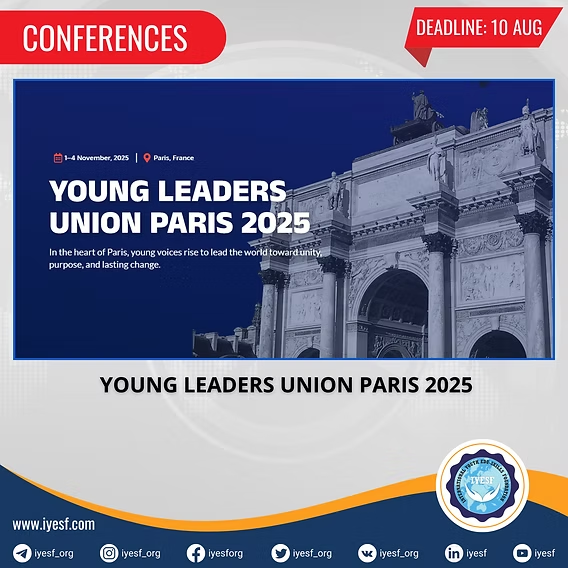
Young Leaders Union Conference 2025 in Paris (Fully Funded)
Join Global Changemakers in Paris! Fully Funded International Conference for Students, Professionals, and Social Leaders from All Nationalities and Fields

Yer yürəsinin daxili nüvəsində struktur dəyişiklikləri aşkar edilib
bu nəzəriyyənin doğru olmadığı məlum olub. Seismik dalğalar vasitəsilə aparılan tədqiqatda daxili nüvənin səthindəki dəyişikliklərə dair qeyri-adi məlumatlar əldə edilib.

Lester B Pearson Scholarship 2026 in Canada (Fully Funded)
Applications are now open for the Lester B Pearson Scholarship 2026 at the University of Toronto!