Applying to KAUST - Your Complete Guide for Masters & Ph.D. Programs (Upcoming Admissions)
Admissions Overview & Key Requirements


File: Freepik
According to The Korea Herald, the ministry announced that applications are now open for teachers who wish to be sent abroad for the fall semester to nine countries: Cambodia, Hungary, Kazakhstan, Kyrgyzstan, Laos, Sri Lanka, Tajikistan, Uzbekistan, and Vietnam.
Separately, teachers for four other countries were selected in April, with two going to Brazil, two to India, one to the Philippines, and 47 to Thailand.
The selected teachers will work at local elementary, middle, and high schools for up to 10 months, with the possibility of extension for an additional term. They will receive monthly living allowances of approximately $2,700 to $2,950, along with local insurance coverage, emergency evacuation and repatriation services, and round-trip airfare, according to the ministry.
The overseas Korean-language teaching program began in 2011 when teachers were first sent to Thailand at the request of the Thai government following a bilateral summit in 2009. Since then, the program has expanded significantly.
As of last year, a total of 1,024 Korean-language teachers have been dispatched to 21 countries. This year, Thailand will receive the largest number of teachers, followed by Uzbekistan with 25.
Of the 25 teachers assigned to Uzbekistan, 20 were invited by the Uzbek government, which will also help cover their allowances as part of efforts to expand Korean-language education in regional cities.
Korean-language education in Uzbekistan has grown rapidly, with the number of schools offering Korean classes and student enrollment increasing by more than 300% over the past five years. However, access remains uneven, as most locally trained teachers are concentrated in the capital, Tashkent.
“The role of capable Korean-language teachers is crucial to promoting Korean-language education overseas,” said Lee Nan-young, director general for international education planning at the ministry. “We will continue to work closely with local governments to strengthen support for Korean-language education.”
Share
Applying to KAUST - Your Complete Guide for Masters & Ph.D. Programs (Upcoming Admissions)
Admissions Overview & Key Requirements

An mRNA cancer vaccine may offer long-term protection
A small clinical trial suggests the treatment could help keep pancreatic cancer from returning

Registration Opens for SAF 2025: International STEAM Azerbaijan Festival Welcomes Global Youth
The International STEAM Azerbaijan Festival (SAF) has officially opened registration for its 2025 edition!
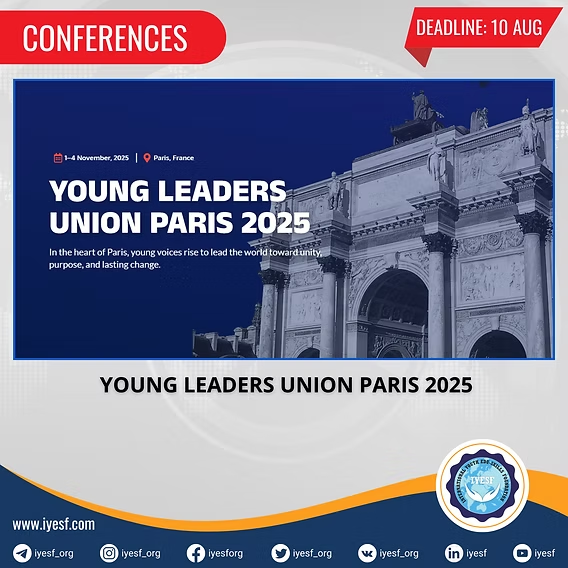
Young Leaders Union Conference 2025 in Paris (Fully Funded)
Join Global Changemakers in Paris! Fully Funded International Conference for Students, Professionals, and Social Leaders from All Nationalities and Fields

Yer yürəsinin daxili nüvəsində struktur dəyişiklikləri aşkar edilib
bu nəzəriyyənin doğru olmadığı məlum olub. Seismik dalğalar vasitəsilə aparılan tədqiqatda daxili nüvənin səthindəki dəyişikliklərə dair qeyri-adi məlumatlar əldə edilib.

Lester B Pearson Scholarship 2026 in Canada (Fully Funded)
Applications are now open for the Lester B Pearson Scholarship 2026 at the University of Toronto!