Applying to KAUST - Your Complete Guide for Masters & Ph.D. Programs (Upcoming Admissions)
Admissions Overview & Key Requirements

.jpg)
Tamar Brand-Perez, a lecturer in human biology, at the Feb. 10 Teaching with AI Community Share-out / File: Stanford Report
The program is led by AI Meets Education (AIMES) and the Stanford Learning Accelerator. The grants will fund the development of courses, academic research, and scholarly work focused on critical issues at the intersection of AI and education.
Associate Vice Provost for Education Kassandra Volpe Horii said the initiative aims to attract a wide range of perspectives, including those who may question the role of AI in education. She emphasized the importance of exploring how learning can be improved in a world where AI exists, regardless of whether it is used directly.
AIMES grew out of the Center for Teaching and Learning and the Office of the Vice Provost for Undergraduate Education, with the goal of supporting critical engagement with generative AI in teaching. The new initiative expands this work by incorporating research expertise from across campus.
The effort is backed by university leadership, including President Jonathan Levin and Provost Jenny Martinez, and is designed to move beyond discussion into concrete action. Vice Provost Jay Hamilton noted that innovation requires time and resources, which the grants are intended to provide.
The initiative includes three main funding tracks:
Experts such as Roy Pea warn that AI risks simply automating ineffective teaching methods if not used thoughtfully. Applicants are therefore encouraged to consider how new technologies can enable entirely new forms of teaching, rather than just faster versions of existing ones.
The initiative also acknowledges potential risks, including reduced critical thinking and overreliance on shortcuts in learning. For this reason, the first Thought Leadership track focuses specifically on critical thinking. Stanford leaders believe the program will help strengthen students’ analytical skills and ensure that AI is integrated into education in a thoughtful and human-centered way.
Share
Applying to KAUST - Your Complete Guide for Masters & Ph.D. Programs (Upcoming Admissions)
Admissions Overview & Key Requirements

An mRNA cancer vaccine may offer long-term protection
A small clinical trial suggests the treatment could help keep pancreatic cancer from returning

Registration Opens for SAF 2025: International STEAM Azerbaijan Festival Welcomes Global Youth
The International STEAM Azerbaijan Festival (SAF) has officially opened registration for its 2025 edition!
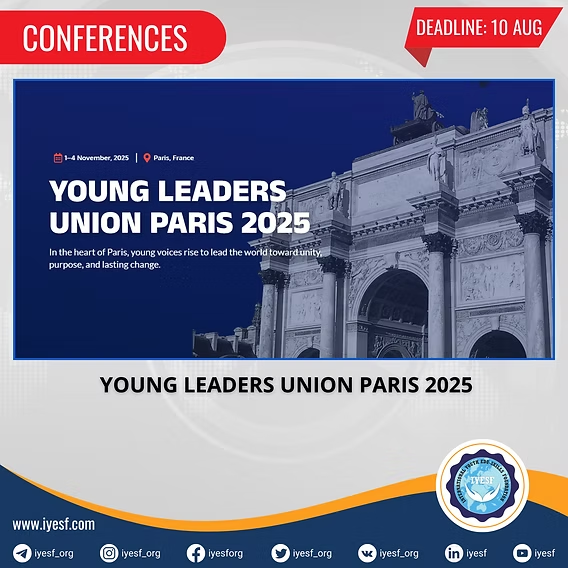
Young Leaders Union Conference 2025 in Paris (Fully Funded)
Join Global Changemakers in Paris! Fully Funded International Conference for Students, Professionals, and Social Leaders from All Nationalities and Fields

Yer yürəsinin daxili nüvəsində struktur dəyişiklikləri aşkar edilib
bu nəzəriyyənin doğru olmadığı məlum olub. Seismik dalğalar vasitəsilə aparılan tədqiqatda daxili nüvənin səthindəki dəyişikliklərə dair qeyri-adi məlumatlar əldə edilib.

Lester B Pearson Scholarship 2026 in Canada (Fully Funded)
Applications are now open for the Lester B Pearson Scholarship 2026 at the University of Toronto!