Applying to KAUST - Your Complete Guide for Masters & Ph.D. Programs (Upcoming Admissions)
Admissions Overview & Key Requirements

The Times Higher Education (THE) World University Rankings by Subject 2026 have been officially released, revealing significant shifts in global higher education performance across 11 academic subject areas. While Asian universities continue to achieve notable milestones in science, technology, engineering and mathematics (STEM), the latest data shows they are now rising fastest in humanities and social sciences, outpacing many of their European and North American counterparts.
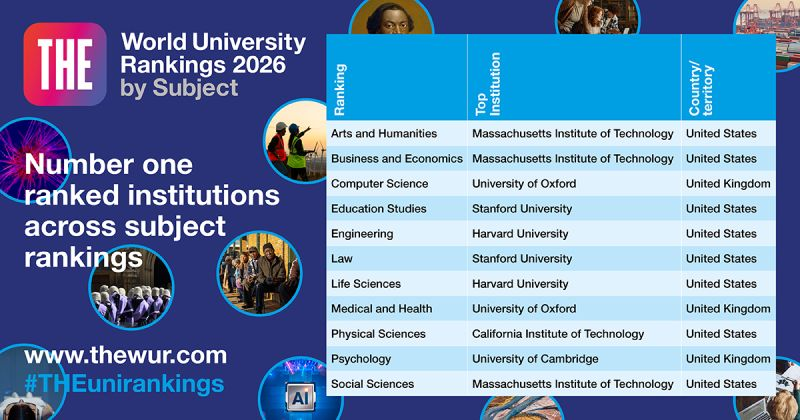
At the very top of the rankings, elite institutions in the United States and the United Kingdom continue to dominate.
The Massachusetts Institute of Technology (MIT) retained its leading position in arts and humanities, business and economics, and social sciences, repeating its performance from last year. Elsewhere in the US, Stanford University topped the rankings in education and law, Harvard University claimed first place in engineering and life sciences, while the California Institute of Technology (Caltech) led the table in physical sciences. In general, the United States tops eight subject rankings.
UK universities secured the top positions in three of the 11 subject rankings. The University of Oxford ranked first in both computer science and medical and health, while the University of Cambridge overtook Stanford to lead the psychology rankings.
Notably, only three institutions – Harvard, Stanford and Cambridge – appeared in the top 10 across all 11 subject areas, underscoring their exceptional breadth of academic strength.
Mainland Europe has one top-10 university: ETH Zurich in Switzerland is third for Computer Science and ninth in Physical Sciences.
Beyond the familiar names at the top, the 2026 rankings reveal deeper structural changes, particularly across Asia.
China expanded its presence in the global top 10, gaining three additional top-10 positions compared with last year. Peking University rose to 10th place in computer science and eighth in engineering, while Tsinghua University entered the top 10 in physical sciences.
Combined with its existing top-10 placements in education and business, China now holds seven top-10 positions across subject rankings up from four last year.
Additionally, three Asian universities – Tsinghua University, Peking University, National University of Singapore – are in the top 10 for Business and Economics for the first time. In the law category, Australia rejoins the top 10 with University of Melbourne in eighth place.
Overall, 17 percent of Asian universities improved their rankings in life sciences, 16 per cent in physical sciences, and 19 per cent in computer science, reinforcing the region’s continued strength in STEM fields.
The most striking trend in the 2026 rankings is Asia’s accelerated rise in non-STEM disciplines.
Almost half of Asian universities (47 per cent) improved their positions in law, while 32 per cent rose in education, 29 per cent in arts and humanities, and 26 per cent in business and economics. Three Asian institutions entered the top 10 for business and economics for the first time.
By comparison, only 13 per cent of European universities and 17 per cent of North American universities improved their positions in arts and humanities, highlighting a widening momentum gap.
According to Professor Futao Huang of the Research Institute for Higher Education at Hiroshima University, Asia’s growth in science has not stalled but is entering a new phase.
“As institutions approach the global frontier, marginal gains naturally become harder,” Huang explained. “At the same time, policy attention and institutional investment in many Asian systems are now expanding beyond STEM, which partly explains the faster upward movement we are seeing in areas such as law, education, and arts and humanities.”
Huang noted that under supportive conditions, Asian universities could break into the global top 10 in arts and humanities within the next decade, though progress will vary by country. While Japan has long-standing strengths in these fields and China has the scale to compete, Singapore may be best positioned in the short to medium term, due to its strong English-language environment, highly internationalised faculty, and open academic culture.
- Arts and Humanities
- Business and Economics
- Computer Science
- Education Studies
- Engineering
- Law
- Life Sciences
- Medical and Health
- Physical Sciences
- Psychology
- Social Sciences
The THE World University Rankings by Subject 2026 assess institutions using a refined version of the overall World University Rankings methodology, applying 18 performance indicators grouped into five core pillars: teaching, research environment, research quality, industry, international outlook.
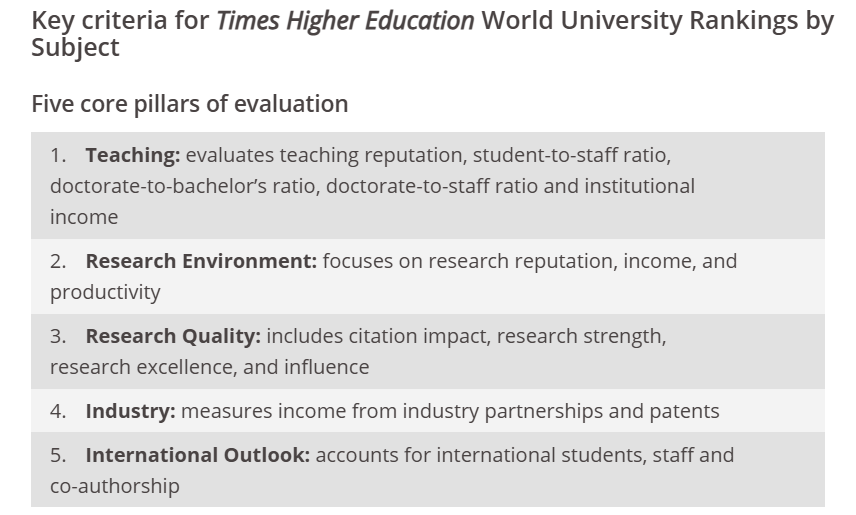
Each subject ranking is recalibrated to reflect disciplinary differences in research culture and publication practices. As a result, indicator weightings vary by subject. For example, in arts and humanities, where scholarly output extends beyond peer-reviewed journals, citation impact carries less weight, while reputation indicators are more prominent. Meanwhile, in engineering and computer science, greater emphasis is placed on research productivity, industry income, and patents, reflecting closer links with applied research and innovation.
This subject-level recalibration ensures fairer comparisons across disciplines with fundamentally different academic traditions.
The full breakdown of subject disciplines and indicator weightings is published on the official Times Higher Education website at the link below.
Share
Applying to KAUST - Your Complete Guide for Masters & Ph.D. Programs (Upcoming Admissions)
Admissions Overview & Key Requirements

An mRNA cancer vaccine may offer long-term protection
A small clinical trial suggests the treatment could help keep pancreatic cancer from returning

Registration Opens for SAF 2025: International STEAM Azerbaijan Festival Welcomes Global Youth
The International STEAM Azerbaijan Festival (SAF) has officially opened registration for its 2025 edition!
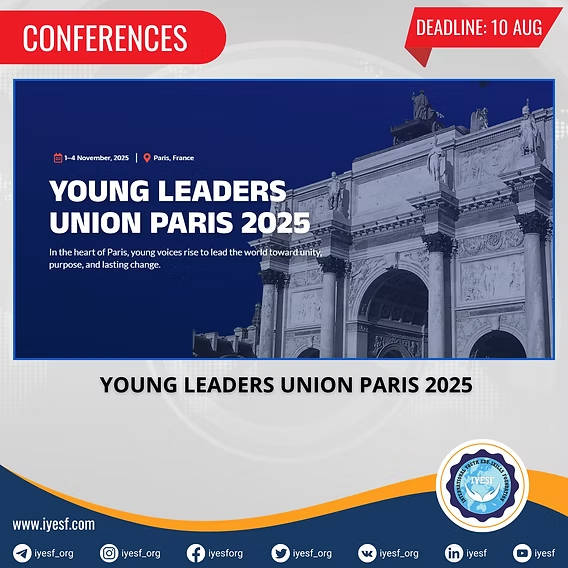
Young Leaders Union Conference 2025 in Paris (Fully Funded)
Join Global Changemakers in Paris! Fully Funded International Conference for Students, Professionals, and Social Leaders from All Nationalities and Fields

Yer yürəsinin daxili nüvəsində struktur dəyişiklikləri aşkar edilib
bu nəzəriyyənin doğru olmadığı məlum olub. Seismik dalğalar vasitəsilə aparılan tədqiqatda daxili nüvənin səthindəki dəyişikliklərə dair qeyri-adi məlumatlar əldə edilib.

Lester B Pearson Scholarship 2026 in Canada (Fully Funded)
Applications are now open for the Lester B Pearson Scholarship 2026 at the University of Toronto!