
Applying to KAUST - Your Complete Guide for Masters & Ph.D. Programs (Upcoming Admissions)
Admissions Overview & Key Requirements

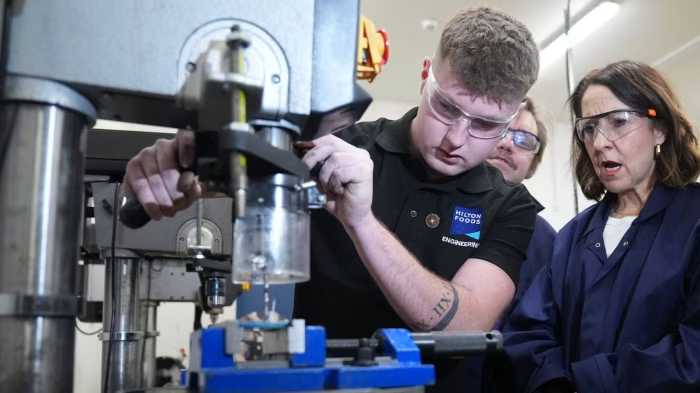
The UK government has announced plans to introduce new V-level courses for 16-year-olds, aiming to simplify what ministers describe as a “confusing landscape” of post-GCSE qualifications in England. The qualification is designed as an option for young people who want work-focused training in areas like engineering or creative industries.
Under the new plan, V-levels will replace many existing Level 3 BTecs and other technical courses, offering students a more accessible and flexible route into employment or further study. The move comes as part of a broader effort to simplify what ministers have called a “confusing landscape” of over 900 available qualifications.
It is not yet clear when V-levels will be introduced, how they will be rolled out, or which subjects will be on offer, although the Department for Education (DfE) gave craft and design and media, broadcast and production as examples.
Speaking to BBC Breakfast, Education Secretary Bridget Phillipson said the new courses would simplify a "fragmented" and "confusing" system for young people, while giving them a "vocational route into great careers".
The necessity for a third route stems from the highly specific nature of the two-year T-levels. A T-level is equivalent in size to three A-levels and is designed to prepare a student for a single, specific occupation through a blend of classroom learning and a substantial 315-hour industry placement. As Skills Minister Baroness Jacqui Smith noted, T-levels suit students who "really know that's what [they] want to do."
V-levels, however, are being introduced as a broader, more flexible vocational alternative, allowing students to explore different sectors before committing to a specialization. Unlike the full-time T-level commitment, V-levels will be a similar size to an A-level, which means students will be able to mix and match by combining them with A-levels.
The government also plans to introduce a new qualification for students who repeatedly fail to achieve a grade 4 in GCSE English or maths.
Currently, those pupils are required to resit exams while continuing other studies. The new course aims to act as a bridge qualification to improve confidence and skills before resits.
The Department for Education said this would “break down barriers to opportunity,” noting that working-class pupils are twice as likely to resit core subjects compared to their more advantaged peers.
Share
Applying to KAUST - Your Complete Guide for Masters & Ph.D. Programs (Upcoming Admissions)
Admissions Overview & Key Requirements

An mRNA cancer vaccine may offer long-term protection
A small clinical trial suggests the treatment could help keep pancreatic cancer from returning

Registration Opens for SAF 2025: International STEAM Azerbaijan Festival Welcomes Global Youth
The International STEAM Azerbaijan Festival (SAF) has officially opened registration for its 2025 edition!

Young Leaders Union Conference 2025 in Paris (Fully Funded)
Join Global Changemakers in Paris! Fully Funded International Conference for Students, Professionals, and Social Leaders from All Nationalities and Fields

Yer yürəsinin daxili nüvəsində struktur dəyişiklikləri aşkar edilib
bu nəzəriyyənin doğru olmadığı məlum olub. Seismik dalğalar vasitəsilə aparılan tədqiqatda daxili nüvənin səthindəki dəyişikliklərə dair qeyri-adi məlumatlar əldə edilib.

Lester B Pearson Scholarship 2026 in Canada (Fully Funded)
Applications are now open for the Lester B Pearson Scholarship 2026 at the University of Toronto!