Applying to KAUST - Your Complete Guide for Masters & Ph.D. Programs (Upcoming Admissions)
Admissions Overview & Key Requirements


The government of Uzbekistan has approved a new system that allows employers to finance the tuition fees of university students in exchange for guaranteed employment after graduation. The initiative, formalized through Cabinet Resolution No. 8 dated January 9, 2026, aims to strengthen cooperation between higher education institutions and major employers, improve the quality of workforce preparation, and increase the attractiveness of higher education for prospective students.
According to the new regulation, employers that have at least 50 employees or operate investment projects valued at a minimum of one million US dollars will now be able to participate in tripartite agreements with universities and students. Within this partnership, the employer covers the student’s contract-based tuition fees during the period of study, while the student commits to working at the sponsoring organization upon completing their degree. The agreement will be formalized through a legally binding three-party contract signed by the employer, the higher education institution, and the student.
The process requires universities to collect information from employers each year regarding their projected staffing needs, the positions available, salary levels, work conditions, and the qualifications expected from students. Universities then publish these opportunities on their official platforms by September 10, allowing eligible second-year and senior students to apply. Students must submit an electronic application together with their academic transcript no later than September 20. The regulation requires applicants to maintain a GPA of at least 3.0 for the current academic year, though universities may introduce adjustments in coordination with participating employers.
Candidate selection is carried out by a special committee formed by the university administration. The committee includes both university staff and representatives of the employer, whose assessment plays a decisive role in identifying suitable candidates. By October 15, all shortlisted students undergo an interview in which they are evaluated on their understanding of sector-specific reforms, their motivation to work with the employer, their academic knowledge within their field of study, and their commitment to fulfilling the conditions of the tripartite contract. Students who successfully pass the interview proceed to sign the agreement, ensuring that their tuition fees will be covered and their job placement secured.
The regulation also introduces several academic components designed to better align university curricula with labor market needs. Universities may incorporate additional elective modules based on employers’ requests, and students who participate in the program may select these modules and receive academic credit for them. Employers are granted the right to monitor the academic progress of participating students at the end of each semester. Furthermore, the topic of the student’s final thesis will be determined in coordination with the employer, taking into account the organization’s activities or ongoing investment projects.
Upon completing their studies, students who were trained under the tripartite system are guaranteed employment with the sponsoring organization. The Ministry of Higher Education, Science and Innovation has been tasked with ensuring that all relevant regulations and administrative procedures are aligned with the newly introduced system.
Share
Applying to KAUST - Your Complete Guide for Masters & Ph.D. Programs (Upcoming Admissions)
Admissions Overview & Key Requirements

An mRNA cancer vaccine may offer long-term protection
A small clinical trial suggests the treatment could help keep pancreatic cancer from returning

Registration Opens for SAF 2025: International STEAM Azerbaijan Festival Welcomes Global Youth
The International STEAM Azerbaijan Festival (SAF) has officially opened registration for its 2025 edition!
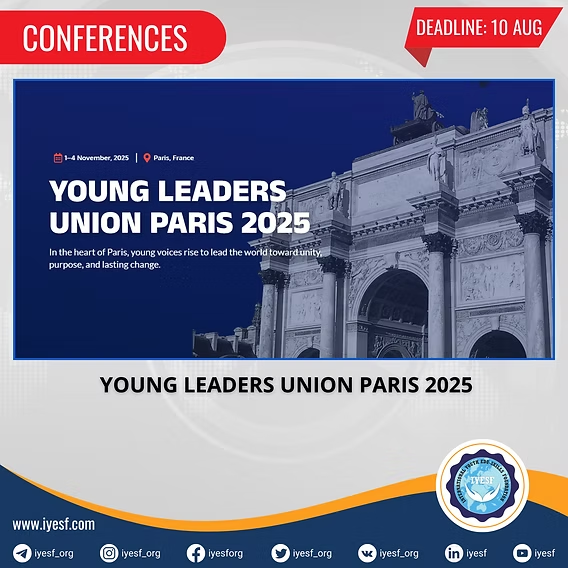
Young Leaders Union Conference 2025 in Paris (Fully Funded)
Join Global Changemakers in Paris! Fully Funded International Conference for Students, Professionals, and Social Leaders from All Nationalities and Fields

Yer yürəsinin daxili nüvəsində struktur dəyişiklikləri aşkar edilib
bu nəzəriyyənin doğru olmadığı məlum olub. Seismik dalğalar vasitəsilə aparılan tədqiqatda daxili nüvənin səthindəki dəyişikliklərə dair qeyri-adi məlumatlar əldə edilib.

Lester B Pearson Scholarship 2026 in Canada (Fully Funded)
Applications are now open for the Lester B Pearson Scholarship 2026 at the University of Toronto!