Applying to KAUST - Your Complete Guide for Masters & Ph.D. Programs (Upcoming Admissions)
Admissions Overview & Key Requirements


A new study conducted by scientists has shown that children who spend more time playing video games demonstrate an increase in intelligence levels. The research, published in Scientific Reports, somewhat contradicts the existing belief that “video games are harmful to children.”
As part of the Adolescent Brain Cognitive Development Study (ABCD Study) — a large-scale, long-term research project examining brain and cognitive development in adolescents in the United States — researchers analyzed screen time data from 9,855 children aged 9–10. According to the findings, children spend an average of 2.5 hours per day watching television and online videos.
Two years later, scientists examined updated data from more than 5,000 of the same children. It was found that children who spent more time playing video games than their peers showed an additional 2.5-point increase in IQ beyond the average growth. This increase was determined based on cognitive indicators such as reading comprehension, memory, flexible thinking, and self-control.
The study also took into account the children’s genetic characteristics and socio-economic status. At the same time, it was determined that watching television and using social media had neither a positive nor a negative impact on intelligence levels.
The authors of the study emphasized that video games stimulate active thinking, attention, memory, and problem-solving skills. This, in turn, has a positive effect on children’s mental development.
At the same time, experts stress the importance of a balanced approach. According to them, these findings do not encourage excessive gaming. The main issue is not the amount of screen time, but its content and purpose.
Share
Applying to KAUST - Your Complete Guide for Masters & Ph.D. Programs (Upcoming Admissions)
Admissions Overview & Key Requirements

An mRNA cancer vaccine may offer long-term protection
A small clinical trial suggests the treatment could help keep pancreatic cancer from returning

Registration Opens for SAF 2025: International STEAM Azerbaijan Festival Welcomes Global Youth
The International STEAM Azerbaijan Festival (SAF) has officially opened registration for its 2025 edition!
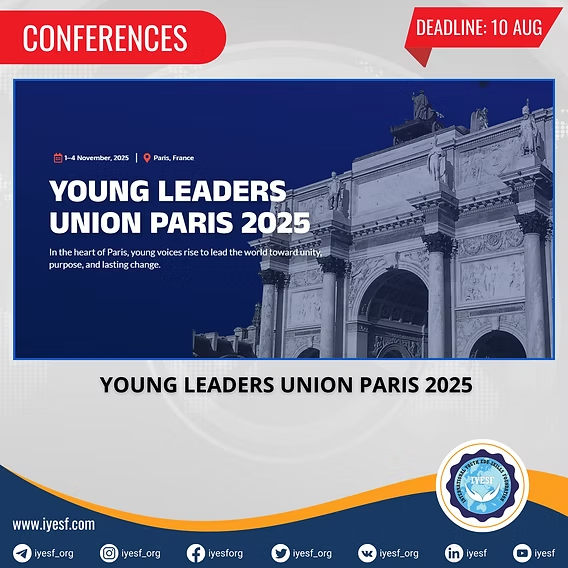
Young Leaders Union Conference 2025 in Paris (Fully Funded)
Join Global Changemakers in Paris! Fully Funded International Conference for Students, Professionals, and Social Leaders from All Nationalities and Fields

Yer yürəsinin daxili nüvəsində struktur dəyişiklikləri aşkar edilib
bu nəzəriyyənin doğru olmadığı məlum olub. Seismik dalğalar vasitəsilə aparılan tədqiqatda daxili nüvənin səthindəki dəyişikliklərə dair qeyri-adi məlumatlar əldə edilib.

Lester B Pearson Scholarship 2026 in Canada (Fully Funded)
Applications are now open for the Lester B Pearson Scholarship 2026 at the University of Toronto!