Applying to KAUST - Your Complete Guide for Masters & Ph.D. Programs (Upcoming Admissions)
Admissions Overview & Key Requirements

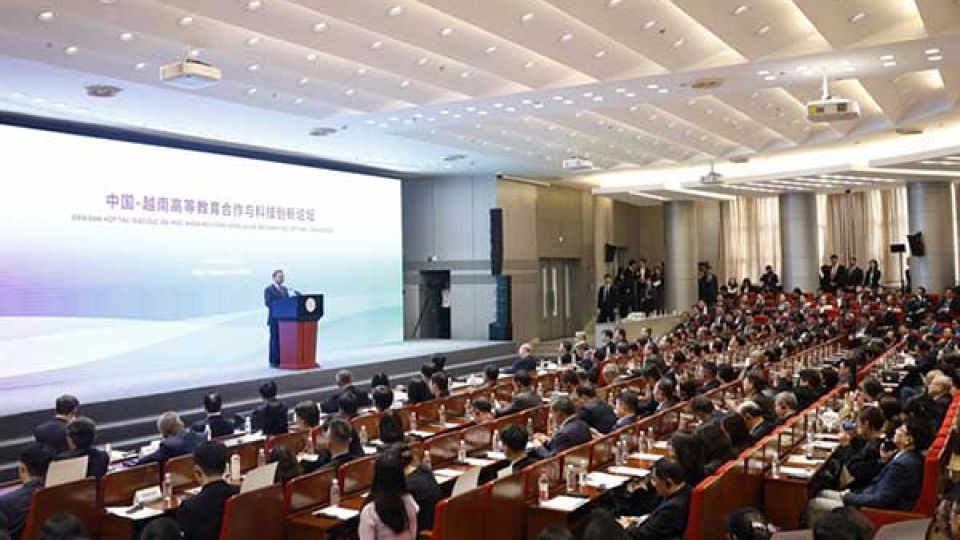
Conference/ File: Asia news network
According to Asia news network, HANOI – Party General Secretary and State President Tô Lâm has said he expects Vietnam–China relations to become stronger in areas such as trade, investment, knowledge sharing, technology, innovation, and shaping future development.
He made these remarks during a policy address at a forum held at Tsinghua University in Beijing as part of his official visit to China, which continues until Friday.
The Vietnam–China Forum on Higher Education, Science, Technology, and Innovation Cooperation was jointly organized by China’s Ministry of Education and Vietnam’s Ministry of Education and Training.
Lâm highlighted that Tsinghua University has educated many individuals who are considered close friends of Vietnam, including Chinese leader Xi Jinping and other senior officials.
He noted that Vietnam and China are neighboring countries with long-standing cultural ties and a history of interaction spanning thousands of years. These relations, he said, have been strengthened by shared aspirations for peace, stability, and development.
The Vietnamese leader welcomed the growing cooperation between Vietnamese educational and research institutions and Tsinghua University, especially in key fields such as artificial intelligence, semiconductors, science and technology, and high-quality workforce development.
Currently, around 25,000 Vietnamese students are studying in China, showing the continued expansion of educational exchanges between the two countries.
He emphasized that Vietnamese students in China, including those at Tsinghua, act as bridges of friendship, cultural representatives, and symbols of youth ambition, openness, and learning spirit. Likewise, Chinese students in Vietnam contribute to deeper mutual understanding between the two peoples.
Lâm stressed that strong bilateral relations must be built on political trust, mutual respect, and shared understanding between the two societies, supported by the commitment of successive generations of leaders.
He also said that lasting friendship should be passed down through generations and strengthened through people-to-people connections, especially among young people.
Alongside official diplomatic engagement, he called for greater focus on exchanges between citizens, youth, universities, and cultural institutions so that both nations’ people feel responsible for preserving the friendship.
He urged deeper and more practical cooperation, focusing on strategic connectivity, measurable outcomes, and mutual benefit as the guiding principles.
According to him, science, technology, innovation, and digital transformation should become key pillars of future bilateral relations.
Lâm added that Vietnam is entering a new stage of development and considers science and innovation essential drivers for achieving its 2030 and 2045 goals. Vietnam is particularly interested in strengthening cooperation with China in areas such as AI, big data, cloud computing, semiconductors, robotics, green technologies, biotechnology, new materials, clean energy, and other strategic industries.
He said education and training, especially workforce development, should be a top priority. He also expressed hope that more Vietnamese students, researchers, and young scientists will study and conduct research in leading Chinese institutions, including Tsinghua University.
He called for expanded collaboration between Tsinghua University and Vietnamese universities and research centers, including joint programs, student exchanges, shared research projects, co-supervised academic work, and the creation of joint laboratories in priority fields.
He further emphasized strengthening youth exchanges so that young people become both inheritors of traditional friendship and active contributors to future development. He highlighted cooperation in addressing challenges in education, healthcare, environment, energy, smart cities, agriculture, and the digital economy.
Lâm expressed confidence that with a strong foundation of friendship, trust, and cooperation in science and innovation-supported by youth engagement as a bridge-Vietnam–China relations will continue to develop steadily and bring long-term benefits to both peoples as well as contribute to regional and global stability.
Share
Applying to KAUST - Your Complete Guide for Masters & Ph.D. Programs (Upcoming Admissions)
Admissions Overview & Key Requirements

An mRNA cancer vaccine may offer long-term protection
A small clinical trial suggests the treatment could help keep pancreatic cancer from returning

Registration Opens for SAF 2025: International STEAM Azerbaijan Festival Welcomes Global Youth
The International STEAM Azerbaijan Festival (SAF) has officially opened registration for its 2025 edition!
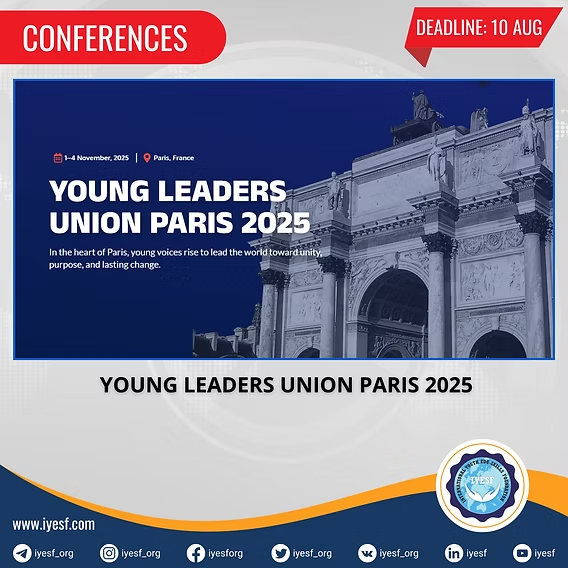
Young Leaders Union Conference 2025 in Paris (Fully Funded)
Join Global Changemakers in Paris! Fully Funded International Conference for Students, Professionals, and Social Leaders from All Nationalities and Fields

Yer yürəsinin daxili nüvəsində struktur dəyişiklikləri aşkar edilib
bu nəzəriyyənin doğru olmadığı məlum olub. Seismik dalğalar vasitəsilə aparılan tədqiqatda daxili nüvənin səthindəki dəyişikliklərə dair qeyri-adi məlumatlar əldə edilib.

Lester B Pearson Scholarship 2026 in Canada (Fully Funded)
Applications are now open for the Lester B Pearson Scholarship 2026 at the University of Toronto!