
Applying to KAUST - Your Complete Guide for Masters & Ph.D. Programs (Upcoming Admissions)
Admissions Overview & Key Requirements


What does SEND mean?
SEND stands for Special Educational Needs and Disabilities. This term applies to children and young people who require extra support to address physical, communication, social, emotional, or mental health needs.
In England, if a child or young person requires more support than what is typically provided in mainstream schools, a parent or guardian can apply for an Education, Health and Care Plan (EHCP). This plan identifies the child's specific needs and the support they must receive. Local councils are legally responsible for overseeing the implementation of EHCPs. These plans can remain in effect until the age of 25, provided the individual stays within the education system
How many children receive SEND support and why number rising?
More than 1.7 million pupils in English schools receive support for special educational needs—accounting for approximately one in five students. About 5% of all pupils (483,000) receive the highest level of support through an EHCP.
In total, 639,000 young people up to the age of 25 have an EHCP in England, a figure that has more than doubled over the last decade. The primary driver of this increase is the rise in Autism Spectrum Disorder (ASD) diagnoses; ASD is now listed as the primary need in one-third of all EHCPs.
Additionally, demand for speech and language therapy has surged following the Covid-19 pandemic. More young people are also seeking support for social, emotional, and mental health issues. According to the Institute for Fiscal Studies (IFS), total spending on SEND has increased by two-thirds over the last decade, driven almost entirely by rising demand.
Who pays for SEND support?
The Office for Budget Responsibility (OBR) forecasts that councils will spend a total of £14.8 billion on SEND in 2025/26, up from £5 billion in 2015/16.
In England, the first £6,000 of basic SEND support for a pupil must be covered by the mainstream school’s budget. Additional costs associated with EHCPs and the full cost of placements in special schools are funded from the local councils' "High Needs Block" budgets.
Councils also pay for approximately 38,000 pupils to attend independent (private) special schools, largely due to a shortage of places in the state sector. According to the IFS, the average annual cost of a place in an independent special school is £61,500, compared to approximately £24,000 in a state-funded special school.
Furthermore, transport for SEND pupils is funded separately by councils. In 2023/24, councils spent £1.5 billion on school transport for 470,000 students—more than double the amount spent in 2015/16.
A system under pressure
In recent years, the cost of SEND services has consistently outpaced funding from the central government, leading to mounting council deficits. The LGA reports that the vast majority of surveyed councils are currently in a SEND-related deficit.
The National Audit Office (NAO) warned in 2024 that the system is "financially unsustainable." Despite a 58% increase in funding by 2024/25, the NAO noted that the system is not delivering better outcomes for children with SEND.
How will the Government reform the SEND system?
The government has outlined key principles for planned reforms in England. These include making mainstream schools more inclusive and reducing the reliance on EHCPs through early intervention.
The government has already announced £3 billion in capital funding to create 50,000 new specialist places. Many of these will be located within mainstream schools, with part of the funding provided by cancelling certain planned "free school" projects. Additionally, £200 million has been pledged for SEND training for teachers.
While some MPs, parents, and campaigners are fighting to protect EHCPs, ministers have not explicitly ruled out the possibility of phasing them out or significantly altering their structure in the future.
Source: BBC
Share
Applying to KAUST - Your Complete Guide for Masters & Ph.D. Programs (Upcoming Admissions)
Admissions Overview & Key Requirements

Registration Opens for SAF 2025: International STEAM Azerbaijan Festival Welcomes Global Youth
The International STEAM Azerbaijan Festival (SAF) has officially opened registration for its 2025 edition!

An mRNA cancer vaccine may offer long-term protection
A small clinical trial suggests the treatment could help keep pancreatic cancer from returning
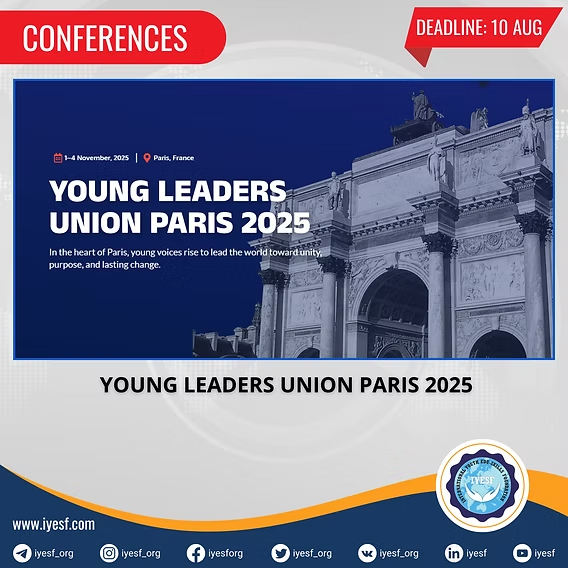
Young Leaders Union Conference 2025 in Paris (Fully Funded)
Join Global Changemakers in Paris! Fully Funded International Conference for Students, Professionals, and Social Leaders from All Nationalities and Fields

Yer yürəsinin daxili nüvəsində struktur dəyişiklikləri aşkar edilib
bu nəzəriyyənin doğru olmadığı məlum olub. Seismik dalğalar vasitəsilə aparılan tədqiqatda daxili nüvənin səthindəki dəyişikliklərə dair qeyri-adi məlumatlar əldə edilib.

Lester B Pearson Scholarship 2026 in Canada (Fully Funded)
Applications are now open for the Lester B Pearson Scholarship 2026 at the University of Toronto!