
Applying to KAUST - Your Complete Guide for Masters & Ph.D. Programs (Upcoming Admissions)
Admissions Overview & Key Requirements

.webp)
Earth/ File: Legal Nomands
According to Science daily, scientists have discovered unexpectedly high concentrations of a little-studied silicone-based pollutant in the atmosphere, raising concerns about potential impacts on human health and the climate. These compounds, called methylsiloxanes, are widely used in cosmetics, industrial applications, transportation systems, and household products. Researchers detected them in many different environments, including large cities, rural areas, and forests.
The study was conducted by researchers from Utrecht University and University of Groningen and was published in the journal Atmospheric Chemistry and Physics.
While pollutants like PFAS and microplastics are already known to be widespread, methylsiloxanes have received far less attention. These water-repelling silicone compounds are commonly used as lubricants and in various consumer and industrial products.
Previously, scientists believed that atmospheric methylsiloxanes mainly came from evaporation of personal care products and industrial materials. However, newer findings show that vehicles and ships emit larger, less volatile forms of these compounds.
The study reveals that these larger molecules are not limited to traffic-heavy regions. Instead, they are present in urban centers, coastal zones, rural regions, and even remote forests, indicating widespread atmospheric distribution.
Rupert Holzinger noted that observed levels were significantly higher than expected.
According to the researchers, methylsiloxanes make up between 2% and 4.3% of total atmospheric organic aerosol mass, making them one of the most abundant synthetic components in airborne particles-far exceeding typical concentrations of PFAS.
Methylsiloxanes are added to lubricants to improve performance, not for combustion. However, during engine operation, small amounts of oil can enter the combustion chamber.
Because these compounds are highly heat-resistant, they do not fully break down during combustion and are released into the air through exhaust emissions.
The highest levels were recorded in cities. In the São Paulo metropolitan region in Brazil, concentrations reached 98 nanograms per cubic meter. Much lower levels were observed in forested areas, such as Rugsteliskis in Lithuania, where levels were around 0.9 nanograms per cubic meter.
Measurements were also taken in Cabauw, a rural village in the Netherlands, where levels reached about 2 nanograms per cubic meter. These samples were collected across Netherlands, Lithuania, and Brazil, representing diverse climates and economic regions.
Because methylsiloxanes are now found almost everywhere in the atmosphere, researchers believe people are continuously exposed through inhalation. However, the long-term health effects are still unknown.
Rupert Holzinger warned that daily inhalation exposure could be comparable to or even higher than that of PFAS and micro- and nanoplastics, highlighting the need for urgent health research.
Scientists also suggest these chemicals may influence climate processes. By altering aerosol properties, methylsiloxanes could affect cloud formation and atmospheric behavior, including surface tension and ice nucleation processes.
The study estimates that more than half of airborne large-molecule methylsiloxanes likely originate from vehicle emissions, particularly from engine lubricants.
Researchers reached this conclusion because these compounds spread through the atmosphere in a pattern similar to long-chain hydrocarbons found in engine oil. However, unlike hydrocarbons, methylsiloxanes remain far more stable, allowing them to persist and travel long distances in the atmosphere without breaking down.
Share
Applying to KAUST - Your Complete Guide for Masters & Ph.D. Programs (Upcoming Admissions)
Admissions Overview & Key Requirements

An mRNA cancer vaccine may offer long-term protection
A small clinical trial suggests the treatment could help keep pancreatic cancer from returning

Registration Opens for SAF 2025: International STEAM Azerbaijan Festival Welcomes Global Youth
The International STEAM Azerbaijan Festival (SAF) has officially opened registration for its 2025 edition!
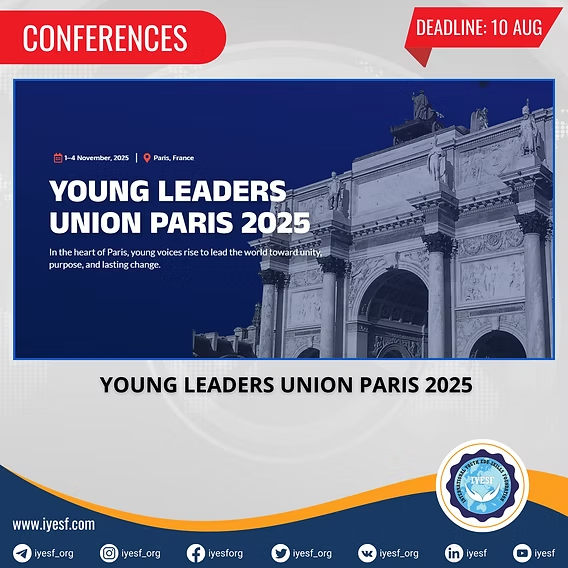
Young Leaders Union Conference 2025 in Paris (Fully Funded)
Join Global Changemakers in Paris! Fully Funded International Conference for Students, Professionals, and Social Leaders from All Nationalities and Fields

Yer yürəsinin daxili nüvəsində struktur dəyişiklikləri aşkar edilib
bu nəzəriyyənin doğru olmadığı məlum olub. Seismik dalğalar vasitəsilə aparılan tədqiqatda daxili nüvənin səthindəki dəyişikliklərə dair qeyri-adi məlumatlar əldə edilib.

Lester B Pearson Scholarship 2026 in Canada (Fully Funded)
Applications are now open for the Lester B Pearson Scholarship 2026 at the University of Toronto!