
Applying to KAUST - Your Complete Guide for Masters & Ph.D. Programs (Upcoming Admissions)
Admissions Overview & Key Requirements

Opportunity type:
Fellowships
Funding Type:
Fully Funded
Regions:
USA
Deadline:
2025-09-28
Opportunity type:
Fellowships
Funding Type:
Fully Funded
Regions:
USA
Deadline:
2025-09-28
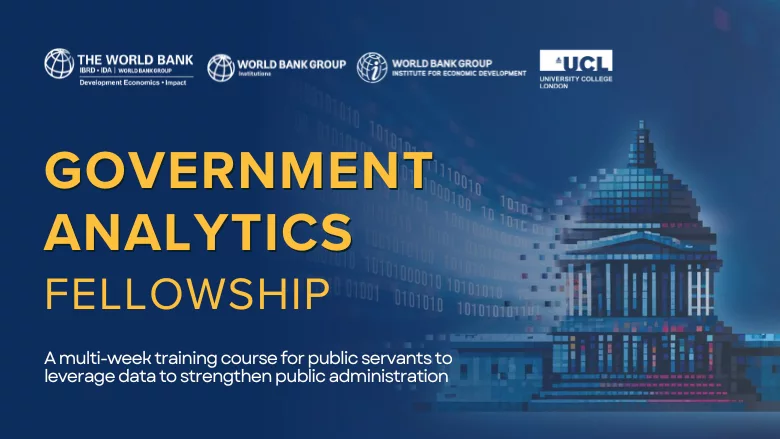
The World Bank Government Analytics Fellowship Program is a pioneering initiative designed to bridge the gap between the vast, yet underutilized, data resources held by governments and the potential for enhanced public administration efficiency through data-informed decision-making.
Leveraging insights from the Government Analytics Handbook and supported by World Bank experts and academics, the Fellowship offers frontier evidence and practitioner insights to enhance government efficiency. The Fellowship is a collaboration between the World Bank Development Economics Vice-Presidency (DEC), the Development Impact Group (DECDI), Institutions Global Department, Institute for Economic Development and University College London (UCL).
The fellowship will comprise a mix of in-person training and in-service support from senior experts at the World Bank and University College London to develop a Government Analytics project.
The fellowship spans 6 months, with a concentrated full-time commitment during the 2 weeks of in-person training in Washington, D.C., which includes the Public Institutions Conference and Government Analytics course.
The World Bank is seeking fellows who will use government data to improve administrative systems, not just policy analysis. Strong applications will propose projects linked to areas such as tax administration, civil service management, or service delivery systems—rather than purely policy-based research. It also means that the data needed for your project must be available (e.g., in administrative records) or can be plausibly collected as part of the fellowship (e.g., through surveys). Applicants are also expected to demonstrate that their projects are feasible with available government data and that they have institutional support for implementation.
The Fellowship is strictly open to government officials, with eligibility limited to those who are:
Important note: Faculty members, students, or employees of private or non-profit organizations are not eligible for this fellowship.
Application deadline: September 28, 2025, at 11:59 PM (ET)
Applicants must submit the following in English:
The letter, CV, and summary should be submitted by the deadline. For any additional questions, e-mail governmentanalytics@worldbank.org
Applicants preparing their proposals can access a range of resources designed to build their understanding of government analytics. Reading the first chapter of the Handbook will give applicants a broad understanding of what government analytics involves. The most important aspect of government analytics is that it is targeted at strengthening the administration of government. They also have a video that acts as an introduction, as well as a series of videos on the Handbook website.
For full details and application instructions, please visit the World Bank Government Analytics Fellowship webpage here.
Share
Applying to KAUST - Your Complete Guide for Masters & Ph.D. Programs (Upcoming Admissions)
Admissions Overview & Key Requirements

An mRNA cancer vaccine may offer long-term protection
A small clinical trial suggests the treatment could help keep pancreatic cancer from returning

Registration Opens for SAF 2025: International STEAM Azerbaijan Festival Welcomes Global Youth
The International STEAM Azerbaijan Festival (SAF) has officially opened registration for its 2025 edition!
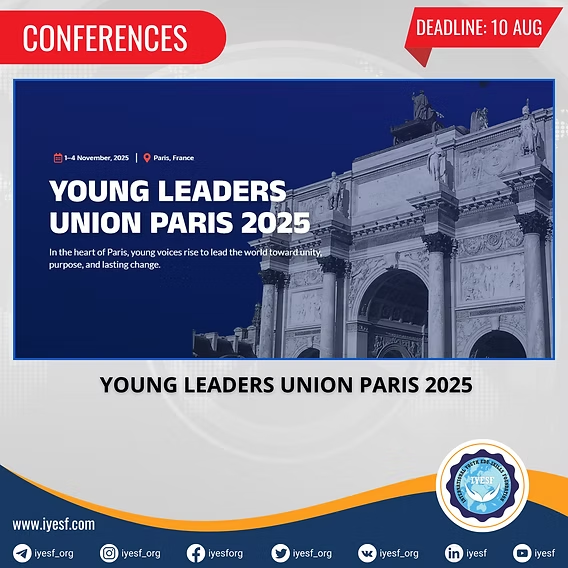
Young Leaders Union Conference 2025 in Paris (Fully Funded)
Join Global Changemakers in Paris! Fully Funded International Conference for Students, Professionals, and Social Leaders from All Nationalities and Fields

Yer yürəsinin daxili nüvəsində struktur dəyişiklikləri aşkar edilib
bu nəzəriyyənin doğru olmadığı məlum olub. Seismik dalğalar vasitəsilə aparılan tədqiqatda daxili nüvənin səthindəki dəyişikliklərə dair qeyri-adi məlumatlar əldə edilib.

Lester B Pearson Scholarship 2026 in Canada (Fully Funded)
Applications are now open for the Lester B Pearson Scholarship 2026 at the University of Toronto!