
Applying to KAUST - Your Complete Guide for Masters & Ph.D. Programs (Upcoming Admissions)
Admissions Overview & Key Requirements


According to The Guardian, the upcoming schools white paper proposes changing the criteria for allocating funding to schools to better support the most disadvantaged pupils. Currently, disadvantage funding in England is distributed based on the number of pupils at a school receiving free school meals, which generally applies to children from families with an annual income of less than £7,400.
Labour wants to expand this criteria and overhaul the funding formula so that allocations are determined more fairly based on family income. This change is likely to move away from the current annual “pupil premium” payments and alter how disadvantage payments are distributed to schools.
The white paper also includes controversial proposals allowing local authorities to manage groups of schools through their own multi-academy trusts and setting new minimum expectations for schools to engage with parents. The overall aim is to reduce the attainment gap and create equal opportunities for all children.
Education Secretary Bridget Phillipson stated that these reforms represent a significant opportunity to break the link between background and success. She said, “Our schools have made great strides in recent decades, yet for too long many children have been let down by a one-size-fits-all system, denied opportunities because they are poor or have additional needs. The schools white paper sets out a plan for a next-generation education system that provides equal opportunities for every child.”
Currently, disadvantage funding for schools amounts to approximately £8 billion per year. Government sources have said that any additional funding required for the proposed changes will be determined in the next spending review. This has led some MPs and campaigners to question how effective the reforms will be without extra funding.
Liberal Democrat education spokesperson Munira Wilson warned that basing funding solely on income could entrench regional inequalities. Pepe Di’Iasio, general secretary of the Association of School and College Leaders, said he supports more targeted funding for disadvantaged pupils but stressed that it must come through additional investment rather than just redistributing existing funds.
The white paper will also outline plans for two new programmes, “Mission North East” and “Mission Coastal,” aimed at improving the performance of disadvantaged pupils in certain areas. These initiatives will be based on the London Challenge model, which focused on raising attainment in secondary schools in the capital and was praised by Ofsted.
As part of the plans, the government also intends to make radical changes to the special educational needs (SEND) system, with every SEND pupil receiving an individual support plan. However, some Labour MPs have expressed concern over whether parents will retain the right to appeal if they are dissatisfied with the level of support their child receives.
The white paper was originally scheduled for publication last autumn but was delayed to allow further consideration of the SEND proposals. Ministers are also expected to announce new attendance targets aimed at recovering 20 million lost school days each year. Additionally, pay rises are planned for newly appointed headteachers to incentivise them to work in areas of greatest need, with increases of up to £15,000 for individual teachers.
Share
Applying to KAUST - Your Complete Guide for Masters & Ph.D. Programs (Upcoming Admissions)
Admissions Overview & Key Requirements

An mRNA cancer vaccine may offer long-term protection
A small clinical trial suggests the treatment could help keep pancreatic cancer from returning

Registration Opens for SAF 2025: International STEAM Azerbaijan Festival Welcomes Global Youth
The International STEAM Azerbaijan Festival (SAF) has officially opened registration for its 2025 edition!
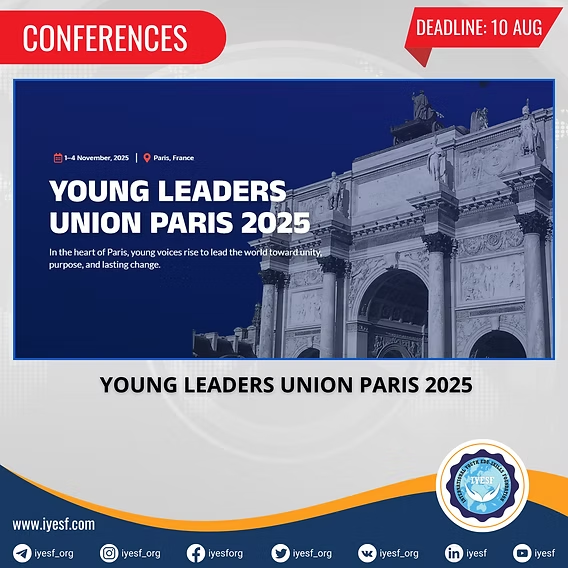
Young Leaders Union Conference 2025 in Paris (Fully Funded)
Join Global Changemakers in Paris! Fully Funded International Conference for Students, Professionals, and Social Leaders from All Nationalities and Fields

Yer yürəsinin daxili nüvəsində struktur dəyişiklikləri aşkar edilib
bu nəzəriyyənin doğru olmadığı məlum olub. Seismik dalğalar vasitəsilə aparılan tədqiqatda daxili nüvənin səthindəki dəyişikliklərə dair qeyri-adi məlumatlar əldə edilib.

Lester B Pearson Scholarship 2026 in Canada (Fully Funded)
Applications are now open for the Lester B Pearson Scholarship 2026 at the University of Toronto!